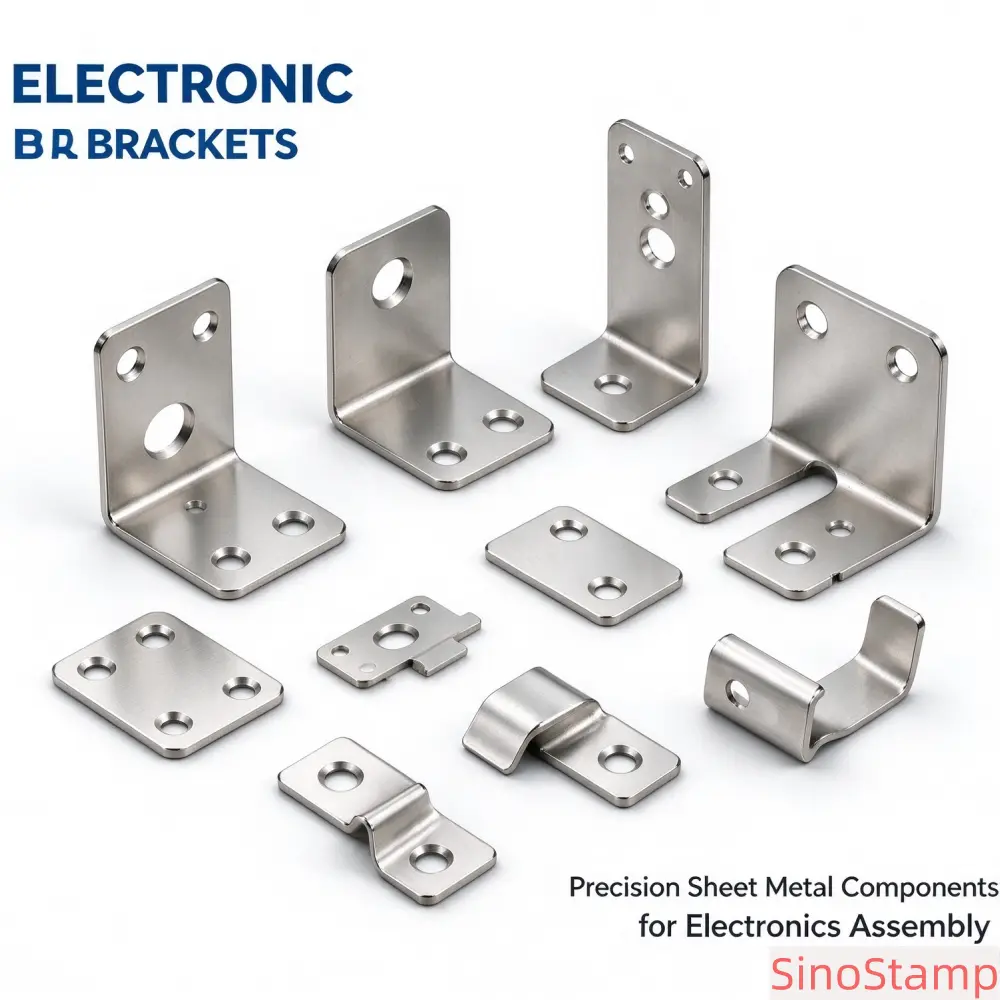
Custom Battery Contact Components Manufacturer for OEM Applications
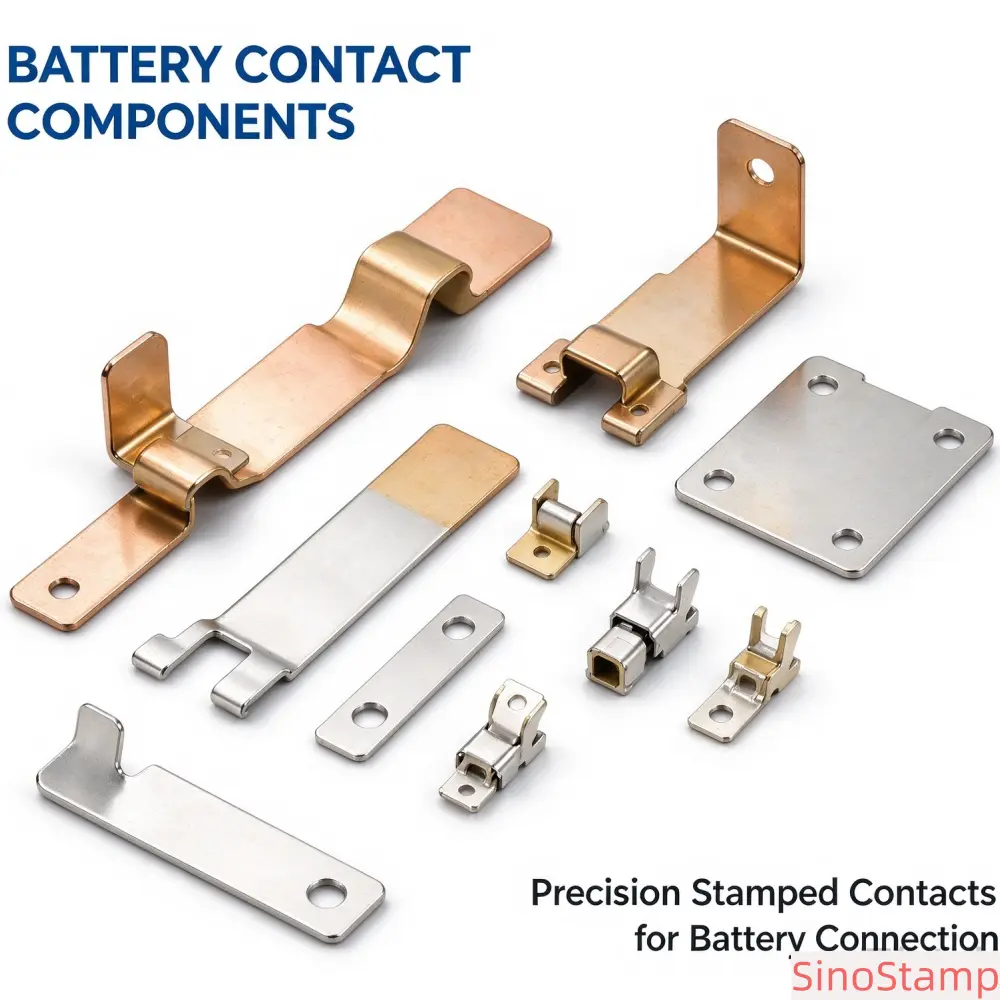
Battery contact components are essential metal parts used to establish reliable electrical connections between batteries and electronic devices. They are commonly installed in battery packs, power tools, consumer electronics, medical devices, portable equipment, and other products that require stable electrical contact and mechanical retention. These components may appear small, but their electrical conductivity, contact pressure, dimensional accuracy, spring characteristics, and surface finish can directly influence the performance and reliability of the final product.
SinoStamp supplies custom battery contact components for international OEM manufacturers, electronic product developers, battery pack assemblers, and industrial equipment companies. Our products are developed according to customer drawings, physical samples, and technical requirements. Through precision metal stamping, bending, forming, and spring-related processing, different contact structures can be manufactured to match specific battery configurations and assembly requirements.
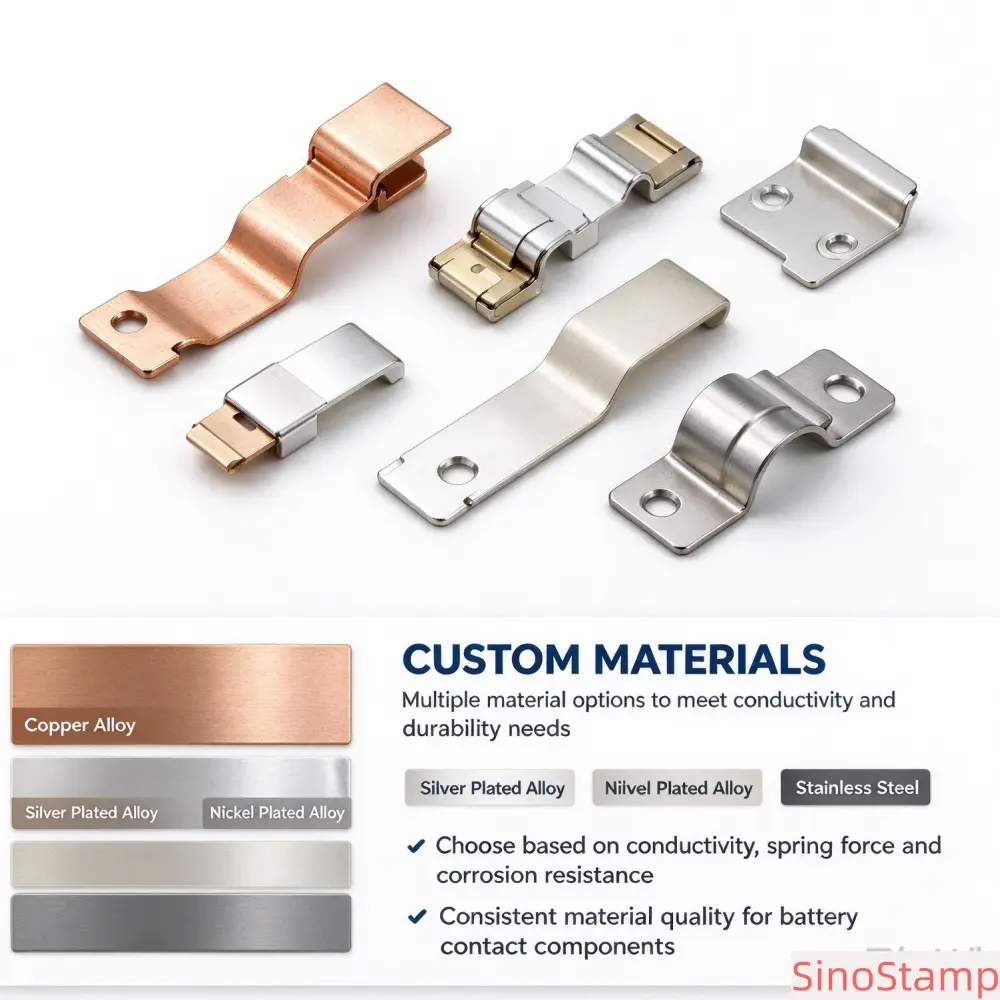
Sunny-1004 is a customizable battery contact component designed for applications requiring dependable electrical contact and secure battery terminal connections. Available material options include stainless steel, phosphor bronze, beryllium copper, and nickel silver. Depending on the application, surface finishing options may include gold plating, silver plating, tin plating, nickel plating, and anti-tarnish treatment.
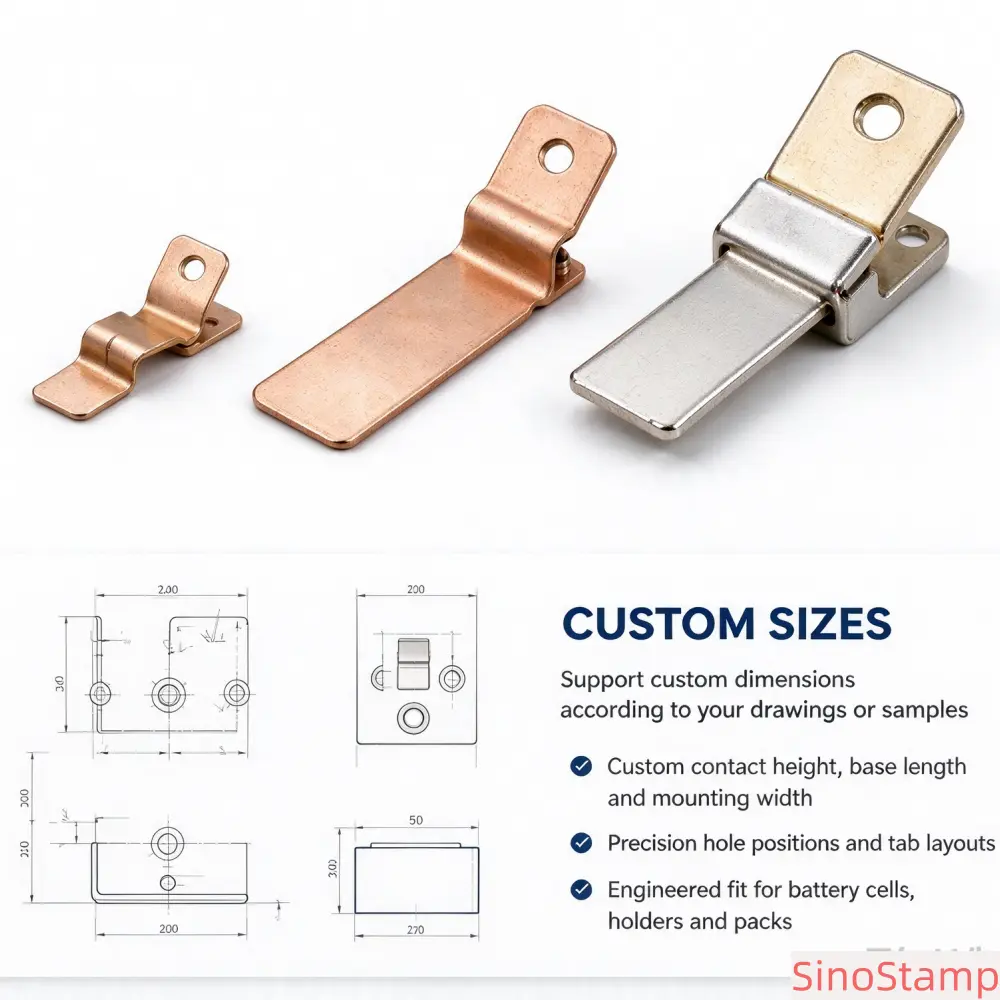
We support OEM and ODM customization for component dimensions, shapes, material thicknesses, contact structures, and contact force requirements. Whether your project requires a simple battery terminal contact, a spring-loaded metal contact, or a customized stamped connector for a battery pack, the design and manufacturing process can be evaluated according to the actual application.
Sunny-1004 Battery Contact Components Overview
Sunny-1004 is a custom metal battery contact component manufactured for electronic products and battery-powered equipment. It is designed to provide electrical contact between battery terminals and the corresponding conductive structures in an electronic assembly.
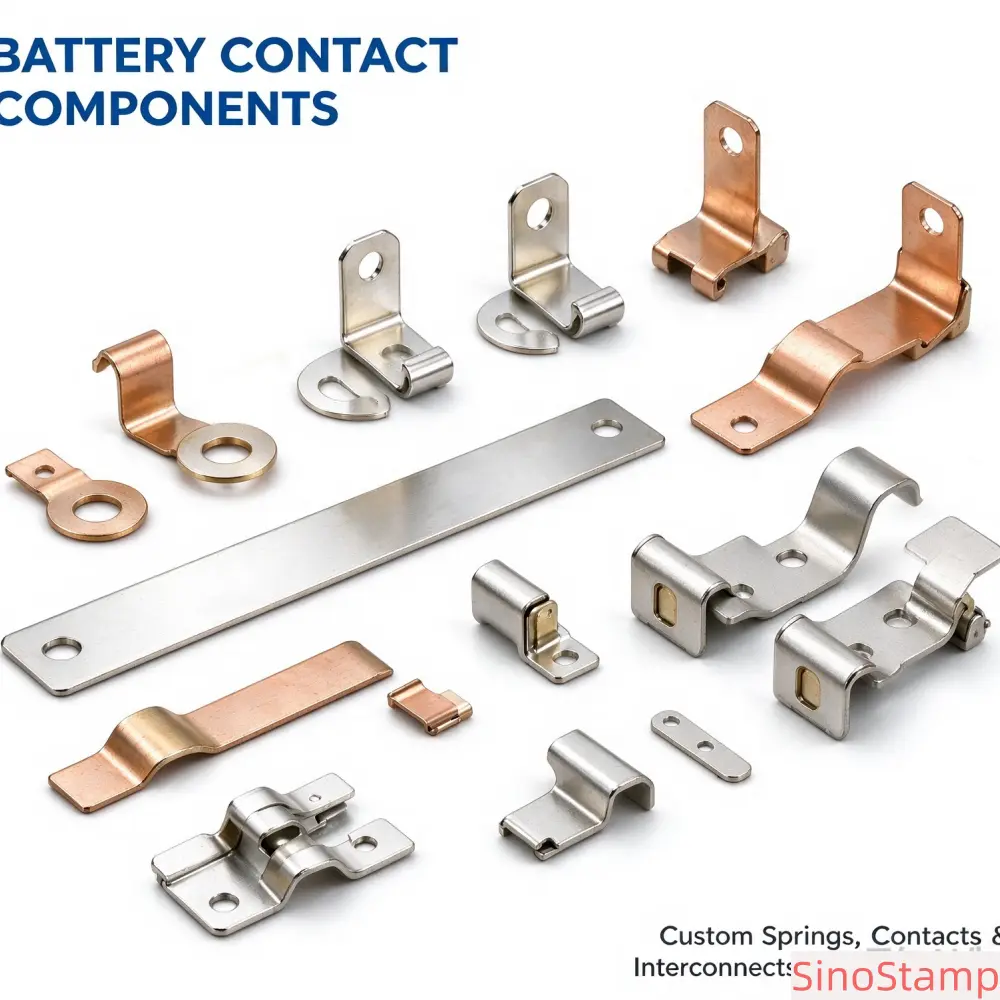
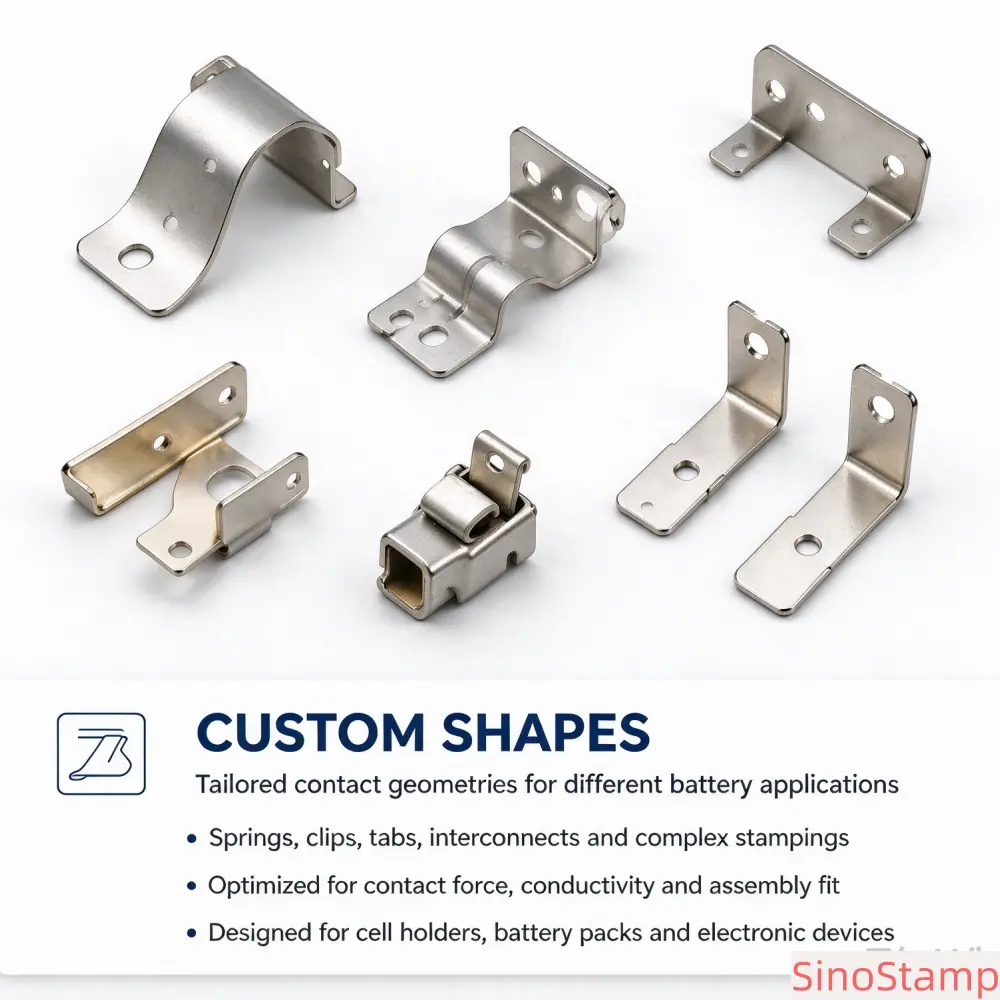
Battery contact components may be designed with flat contact surfaces, spring fingers, formed tabs, retention features, mounting sections, or other customized structures. The exact configuration depends on the battery type, installation method, electrical requirements, and available product space.
- Model No.: Sunny-1004
- Product Name: Battery Contact Components
- Material: Stainless Steel / Phosphor Bronze / Beryllium Copper / Nickel Silver (Customizable)
- Thickness: 0.1mm ~ 0.5mm (Customizable)
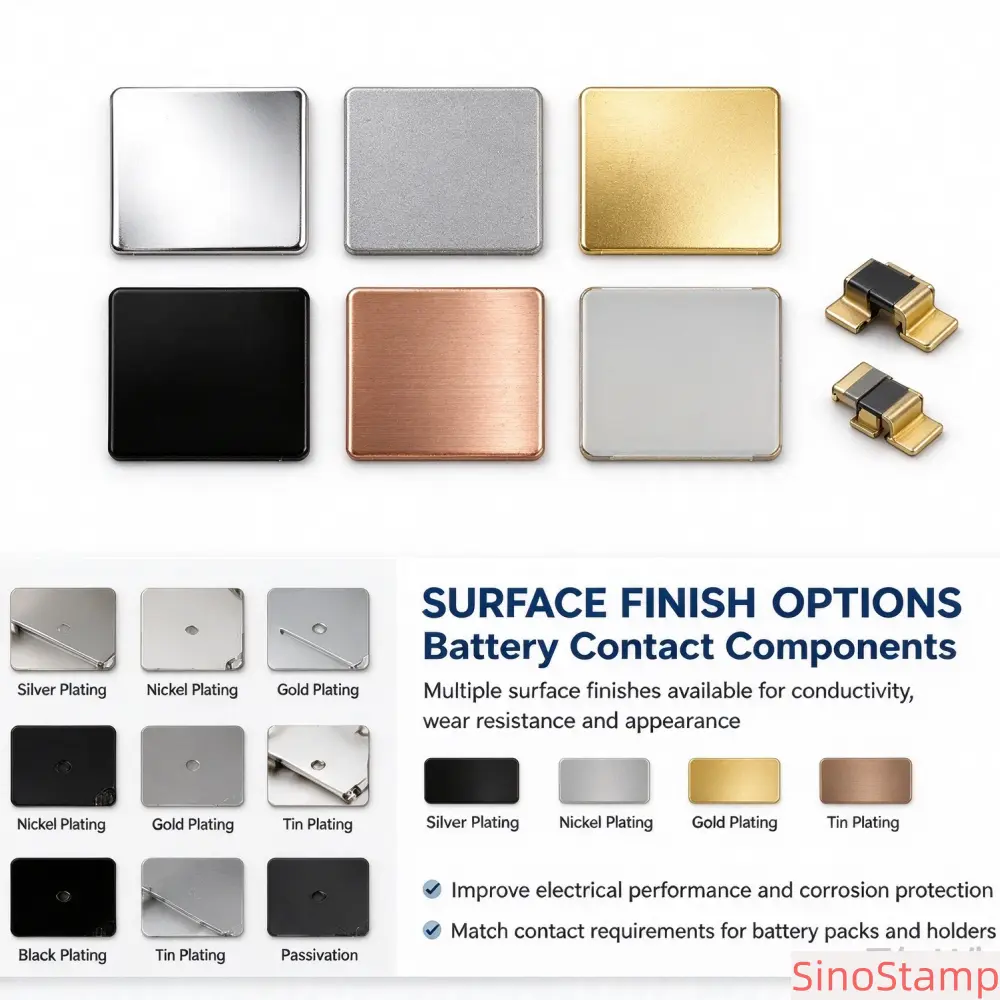
- Surface Finish: Gold plating / Silver plating / Tin plating / Nickel plating / Anti-tarnish treatment
- Processing: Precision stamping, bending, forming, spring tempering
- Function: Reliable electrical contact and secure connection for battery terminals
- Custom Service: OEM & ODM, Custom size, shape, contact force by drawing
- Application: Battery packs, power tools, consumer electronics, medical devices
- Tolerance: ±0.05mm for critical dimensions, subject to design and manufacturing feasibility
- Certification: RoHS, ISO 9001 and CE requirements can be evaluated according to applicable documentation and product scope
- Sample: Support sample testing
- Packing: Anti-static bag + export carton
The final specifications should be confirmed against the approved engineering drawing and material requirements. In particular, contact force, spring behavior, electrical resistance, plating thickness, and dimensional tolerances should be defined according to the intended battery system.
What Are Battery Contact Components?
Battery contact components are conductive metal parts that connect a battery terminal to an electronic device, battery holder, circuit board, or power distribution structure. They provide an electrical pathway while maintaining the mechanical contact required during normal product operation.
Depending on the application, battery contacts can be designed as positive terminal contacts, negative terminal contacts, spring contacts, flat contacts, battery connector terminals, or customized stamped metal connectors.
In many battery-powered products, the contact component must perform two functions at the same time. First, it must maintain a suitable electrical connection with the battery terminal. Second, it must provide enough mechanical stability to remain in position during battery installation, removal, vibration, and normal product use.
These requirements make material selection and structural design especially important. A contact that is too rigid may make battery installation difficult or provide insufficient compensation for dimensional variation. A contact that is too flexible may not maintain adequate contact force over repeated use. The appropriate design must balance conductivity, spring characteristics, mechanical strength, and assembly requirements.
How Battery Contact Components Work
A battery contact component creates an electrical interface between the battery and the device. When a battery is inserted into a battery compartment or connected to a battery pack, the metal contact touches the corresponding terminal. This contact allows electrical current to flow through the designed circuit.
For a reliable connection, the contact surface must remain aligned with the battery terminal and maintain sufficient contact pressure. The component geometry, material properties, surface finish, and installation structure all contribute to this function.
Electrical Contact
The electrical contact surface provides the interface through which current passes between the battery and the device. Material conductivity, contact area, surface condition, and contact pressure can influence electrical resistance.
For applications with higher current requirements, the contact design should be evaluated according to the expected operating current, temperature rise, material thickness, and contact geometry. A suitable design may require a larger contact area, a different material, or a specific plating system.
Mechanical Retention
Battery contacts may include mounting tabs, locking features, folded sections, or spring structures that help maintain their position inside the product. These features must be compatible with the housing, PCB, battery compartment, or battery pack structure.
Mechanical retention is important because movement between the battery terminal and the contact surface can cause intermittent electrical connections. The component should be designed to withstand the expected installation and operating conditions.
Spring Contact Pressure
Many battery contacts use a spring structure to maintain contact pressure against the battery terminal. The spring feature can compensate for certain dimensional variations and help maintain a stable electrical interface.
Contact force depends on material properties, material thickness, spring geometry, forming angle, free length, and deflection. These factors should be considered together during engineering development.
Types of Custom Battery Contact Components
Battery contact components are available in different structural forms according to battery configuration, electrical requirements, and product design. Custom metal stamping allows manufacturers to develop contact geometries for different applications.
Flat Battery Contacts
Flat battery contacts use a relatively simple conductive metal structure to connect with a battery terminal. They may be used in battery compartments, compact electronic devices, and assemblies where the battery position is controlled by the surrounding housing.
The contact surface can be designed with a flat profile or customized shape. Mounting features may be added according to the installation arrangement.
Spring Battery Contacts
Spring battery contacts incorporate formed metal sections that provide elastic movement when the battery is installed. This design can help maintain contact pressure and accommodate certain dimensional variations.
Spring contacts are commonly used in portable electronics, battery holders, handheld equipment, and other battery-powered products. Their performance depends on the selected material, thickness, spring geometry, and operating deflection.
Positive and Negative Battery Contacts
Positive and negative battery contacts are designed to connect with the corresponding terminals of a battery. Their shapes may differ according to the battery configuration and the mechanical arrangement of the device.
Some products require different contact geometries for positive and negative terminals. These components should be clearly identified in the engineering drawings to avoid assembly errors.
Battery Pack Contact Terminals
Battery pack contact terminals connect individual cells, modules, or battery pack output interfaces. Depending on the battery system, these parts may need to support specific current requirements, mechanical connections, and assembly methods.
Material thickness, conductive properties, contact area, and surface finish should be selected according to the electrical and mechanical requirements of the battery pack.
Custom Battery Connector Contacts
Custom battery connector contacts are developed for products with special electrical interfaces or limited installation space. They may include multiple contact points, formed spring fingers, mounting sections, and customized terminal profiles.
OEM customers can provide drawings or physical samples to define the required structure. The manufacturing approach can then be evaluated according to the material, geometry, and production quantity.
Materials for Custom Battery Contact Components
Material selection has a direct influence on the electrical, mechanical, and spring properties of battery contact components. Different materials provide different combinations of conductivity, strength, corrosion resistance, formability, and fatigue behavior.
SinoStamp supports several material options for customized battery contact stamping projects. The final selection should be based on the electrical current, required contact force, operating environment, manufacturing process, and total component cost.
Stainless Steel Battery Contacts
Stainless steel is commonly selected for metal components that require mechanical strength, corrosion resistance, and structural stability. It can be used for selected battery contact designs where mechanical performance and environmental resistance are important.
Different stainless steel grades offer different forming characteristics and mechanical properties. The selected grade should be evaluated according to the contact geometry, required spring behavior, and electrical requirements.
Stainless steel generally has lower electrical conductivity than copper-based contact alloys. Therefore, its suitability for a specific electrical contact should be assessed according to the expected current and allowable resistance.
Phosphor Bronze Battery Contacts
Phosphor bronze is a copper-based alloy commonly used in electrical contact and spring component applications. It combines useful electrical conductivity with mechanical strength and elastic properties.
Phosphor bronze battery contacts may be suitable for designs that require a balance between electrical performance and spring behavior. It can be processed into formed contact structures through precision stamping and bending.
Material grade and temper condition are important considerations. Different conditions can provide different strength, hardness, and spring characteristics. OEM customers should define the required performance rather than specifying only the general material name.
Beryllium Copper Battery Contacts
Beryllium copper is a copper alloy known for its high strength and useful spring characteristics after appropriate processing and heat treatment. It is used in selected electrical contact and precision spring applications where mechanical performance is important.
Beryllium copper may be considered for battery contact structures requiring controlled elastic behavior and repeated deflection. The selected alloy grade and temper should be matched to the component geometry and operating conditions.
Because beryllium-containing materials require appropriate industrial handling and processing controls, suppliers should follow applicable occupational health, environmental, and material safety requirements. OEM buyers should also confirm the relevant material documentation and any restrictions applicable to their target markets.
Nickel Silver Battery Contacts
Nickel silver is a copper-based alloy containing nickel and zinc. Despite its name, it does not contain silver. It is used in selected electronic and precision metal component applications because of its mechanical characteristics, appearance, and corrosion resistance.
Nickel silver may be considered for battery contact components where a specific balance of strength, formability, and surface characteristics is required. The electrical properties depend on the exact alloy composition and grade.
How to Select the Right Material
The best material depends on the intended function of the battery contact. OEM engineers should evaluate the following factors before confirming a material specification:
- Electrical conductivity and expected operating current.
- Required contact resistance and temperature rise limits.
- Spring force and elastic recovery requirements.
- Material thickness and structural strength.
- Repeated installation and removal cycles.
- Corrosion resistance and operating environment.
- Compatibility with the selected plating or surface treatment.
- Manufacturing feasibility and total production cost.
For spring-loaded battery contacts, material temper and mechanical properties are particularly important. Material selection should be confirmed together with the required contact geometry and force specifications.
Material Thickness and Dimensional Customization
Material thickness is an important design parameter for battery contact components. It affects electrical resistance, mechanical strength, spring stiffness, forming behavior, and the overall size of the finished part.
Sunny-1004 supports customizable material thickness from 0.1 mm to 0.5 mm according to the selected material and component design. This range provides flexibility for different contact structures, but the final thickness should be confirmed through engineering evaluation.
Thin-Gauge Battery Contacts
Thin-gauge metal materials may be suitable for compact battery compartments and electronic devices where installation space is limited. They can support lightweight designs and small stamped contact structures.
However, thinner materials may have different spring force and deformation characteristics. The design should consider the required deflection, contact pressure, and expected operating cycles.
Thicker Battery Contact Components
Thicker materials may provide greater mechanical strength and structural rigidity. They may be considered for larger battery terminals or applications with higher mechanical requirements.
Increasing thickness can also change forming requirements and spring stiffness. The contact geometry may need to be adjusted to achieve the required force and deflection.
Critical Dimensions
Important dimensions may include overall length, width, material thickness, contact height, mounting position, spring free length, bending angle, and contact surface location.
For Sunny-1004, a tolerance of ±0.05 mm is specified for critical dimensions, subject to design and manufacturing feasibility. The achievable tolerance should be confirmed according to the material, part geometry, tooling design, and inspection method.
Contact Force and Spring Performance
Contact force is one of the most important functional characteristics of many battery contact components. It determines the mechanical pressure applied between the metal contact and the battery terminal under a specified deflection condition.
Insufficient contact force may result in unstable electrical contact, particularly when the product is exposed to vibration or mechanical movement. Excessive contact force may make battery installation difficult, increase wear, or place unnecessary stress on the battery terminal and surrounding housing.
The required force should therefore be defined according to the battery design and product operating conditions.
Spring Geometry
Spring geometry influences how a battery contact deforms when the battery is inserted. Important design parameters may include spring length, width, thickness, bending angle, curvature, and the position of the contact point.
Different spring profiles can produce different force-deflection characteristics. A suitable geometry should provide the required contact force while remaining within the allowable elastic range of the material.
Material Temper and Elastic Recovery
Material temper influences hardness, strength, and elastic behavior. For spring contacts, the selected material condition must provide suitable recovery after deflection.
Material properties should be confirmed before tooling development. Where heat treatment or spring tempering is part of the approved process, the process requirements should be documented and controlled.
Force-Deflection Evaluation
Contact force can be evaluated by measuring the force required to deflect the contact through a specified distance. The test should define the measurement location, direction, displacement, and acceptance range.
For repeatable results, the test fixture and measurement method should be consistent. OEM customers should provide the target force range and operating deflection wherever possible.
Repeated Deflection and Fatigue
Some battery contacts are designed for products where batteries are frequently installed and removed. Repeated deflection may gradually change spring characteristics depending on the material, stress level, geometry, and operating environment.
For applications requiring repeated battery replacement, spring performance should be evaluated over the expected operating cycles. Testing can help determine whether the contact design maintains acceptable force and electrical continuity during product use.
Precision Metal Stamping Processes for Battery Contacts
Precision metal stamping is widely used to manufacture battery contact components with repeatable dimensions and customized geometries. It is suitable for producing flat contacts, spring terminals, formed contact fingers, and other metal electrical connection parts.
The manufacturing process depends on material characteristics, thickness, part geometry, tolerance requirements, and expected production quantity.
Blanking
Blanking cuts the initial profile of a battery contact from sheet or strip material. The blanking operation establishes the basic outline and provides the starting shape for subsequent forming operations.
For small battery contacts, blanking accuracy is important because it affects the dimensions of the final spring structure and the position of contact features.
Punching
Punching creates holes, slots, and other openings required for mounting, positioning, or assembly. Some battery contact designs include locating holes or retention features that connect with the product housing or supporting structure.
Hole position and edge condition should be controlled according to the approved drawing.
Bending
Bending transforms flat metal blanks into three-dimensional contact structures. It is used to create spring arms, terminal sections, mounting tabs, and other formed features.
Material thickness, bend radius, material direction, and springback should be considered during tooling development. These factors influence the final geometry and contact force.
Precision Forming
Forming operations are used to create customized profiles that cannot be achieved through simple blanking or bending. Depending on the design, forming may produce curved spring sections, raised contact areas, retention structures, and other functional features.
Forming sequence and tooling design should be evaluated to maintain dimensional consistency and reduce unnecessary material stress.
Spring Tempering and Heat Treatment
Some spring contact designs require material conditions that provide suitable strength and elastic recovery. Depending on the selected alloy and supply condition, heat treatment or spring tempering may be part of the manufacturing process.
The exact process should be determined according to the material grade, required mechanical properties, and component design. Heat treatment requirements should be documented and verified where applicable.
Progressive Die Stamping
Progressive die stamping combines multiple stamping operations into a single tooling system. Metal strip material moves through different stations, with each station performing a specific cutting or forming operation.
This method may be suitable for battery contacts with repeated features and stable production demand. It can support efficient repeat manufacturing after tooling development and process stabilization.
For smaller initial quantities or designs that are still being modified, alternative stamping arrangements may be more practical. The appropriate process depends on tooling investment, expected order volume, and long-term production plans.
Surface Finishing Options for Battery Contact Components
Surface finishing plays an important role in battery contact manufacturing. It can influence electrical contact behavior, corrosion resistance, solderability, surface stability, and product appearance.
The most suitable finish depends on the base material, contact function, operating environment, and electrical requirements. Sunny-1004 supports several surface finishing options for customized battery contact components.
Gold Plating
Gold plating is used in selected electronic contact applications where stable surface contact and corrosion resistance are important. It may be considered for battery contacts requiring particular contact performance or environmental durability.
Gold plating specifications should define the coating thickness, coverage area, and any required underlayer. The appropriate plating structure depends on the base material and the electrical requirements of the application.
Gold plating is generally more expensive than several alternative finishes, so it should be specified according to actual functional requirements rather than used automatically on every contact component.
Silver Plating
Silver has excellent electrical conductivity and is used in selected electrical contact applications. Silver-plated battery contacts may be considered where conductive surface properties are important.
Silver surfaces can be affected by tarnishing under certain environmental conditions. The final finish and storage requirements should therefore be evaluated according to the operating environment.
Tin Plating
Tin plating is widely used in electronic and electrical component manufacturing. It can provide a conductive surface finish and may be suitable for battery contacts requiring solderability or compatibility with particular assembly processes.
OEM buyers should define the plating thickness and any requirements related to soldering, contact resistance, corrosion behavior, and surface appearance.
Nickel Plating
Nickel plating can provide a protective surface layer and may be used as a functional coating or an underlayer in a multi-layer plating system.
Its suitability depends on the required electrical contact behavior and the design of the complete coating structure. The plating specification should identify the required thickness and coverage.
Anti-Tarnish Treatment
Anti-tarnish treatment may be applied to selected metal surfaces to reduce discoloration during storage and handling. It can be useful for contacts that need to maintain a stable surface condition before assembly.
The treatment should be compatible with the base material and any subsequent soldering, bonding, or electrical contact process.
How to Select the Right Surface Finish
When choosing a surface finish for battery contact components, OEM engineers should evaluate:
- Required electrical contact resistance.
- Operating current and temperature conditions.
- Corrosion resistance and environmental exposure.
- Compatibility with the battery terminal material.
- Solderability and assembly requirements.
- Expected installation and removal cycles.
- Plating thickness and coverage requirements.
- Storage conditions and product shelf life.
The final finish should be selected according to the application and confirmed through appropriate component or assembly testing.
Electrical Performance and Contact Reliability
Battery contact components are electrical interface parts, so their design must consider the relationship between contact resistance, current capacity, contact pressure, temperature rise, and surface condition.
Contact Resistance
Contact resistance is the electrical resistance at the interface between two conductive surfaces. It can be influenced by material properties, surface finish, contact pressure, surface contamination, and the actual contact area.
For battery-powered equipment, contact resistance should remain within the limits defined by the product design. A suitable testing method should specify the measurement conditions and acceptance criteria.
Current Capacity
The current capacity of a battery contact depends on the material, cross-sectional area, contact geometry, connection method, and thermal conditions. Higher current applications may require different material thicknesses, larger conductive areas, or alternative contact structures.
OEM engineers should provide the expected operating current and any peak current requirements during project evaluation. The contact component should be assessed as part of the complete electrical system.
Temperature Rise
Electrical current flowing through a contact can generate heat. Excessive resistance or unsuitable contact geometry may increase temperature rise during operation.
Temperature evaluation should consider the actual current profile, contact resistance, material, plating, mounting structure, and surrounding thermal environment.
Corrosion and Surface Stability
Battery contacts may be exposed to humidity, temperature changes, handling, and other environmental conditions. Corrosion or surface contamination can influence electrical contact performance.
Material selection and surface finishing should reflect the expected product environment. Where necessary, environmental testing can be included in the customer validation process.
Applications of Custom Battery Contact Components
Custom battery contact components are used in many industries where batteries provide portable or backup power. Different applications have different requirements for current capacity, contact force, installation space, corrosion resistance, and service life.
Battery Packs
Battery packs use metal contact components to connect battery terminals, modules, or output interfaces. Depending on the design, these parts may be used for electrical connection, module interfaces, or other terminal structures.
Battery pack applications may have specific requirements for current capacity, mechanical retention, dimensional accuracy, and electrical resistance. The contact design should be evaluated according to the battery configuration and complete pack structure.
Power Tools
Cordless power tools require reliable electrical connections between removable battery packs and the tool body. Battery contacts must maintain suitable mechanical engagement while supporting the electrical requirements of the tool.
These applications may involve repeated installation and removal, vibration, and demanding operating conditions. Material selection, spring behavior, contact force, and structural stability should be carefully evaluated.
Consumer Electronics
Consumer electronics such as portable devices, electronic accessories, remote controls, and battery-powered products often use compact battery contacts.
These components may require small dimensions, customized spring structures, and suitable surface finishing. Precision stamping can support repeatable production of these small metal parts.
Medical Devices
Battery-powered medical devices may require compact and reliable electrical contact components. The design should consider the device's electrical requirements, operating environment, assembly process, and applicable regulatory requirements.
For medical applications, OEM customers should clearly define material documentation, traceability, cleanliness, validation, and any special quality requirements before production.
Industrial Electronic Equipment
Industrial equipment may use battery contacts in portable instruments, backup power modules, wireless sensors, and other electronic devices.
Depending on the operating environment, contacts may need suitable mechanical strength, corrosion resistance, and stable electrical performance.
Portable Battery-Powered Products
Portable electronic products often require battery contacts that fit into limited spaces while providing reliable electrical connections. Customized stamped contacts can be designed to match the housing and battery configuration.
Quality Control for Battery Contact Components
Quality control is essential for battery contact components because variations in dimensions, spring behavior, surface finish, and electrical characteristics can affect the final product.
A suitable inspection process should cover incoming materials, tooling trials, in-process production, surface finishing, and final component inspection.
Incoming Material Inspection
Incoming inspection may include checking material grade, thickness, surface condition, and batch identification. Material certificates and technical documentation can be reviewed according to customer requirements.
For spring contact applications, material temper and mechanical properties should be confirmed where they are critical to the design.
Dimensional Inspection
Dimensional inspection may include overall length, width, thickness, contact height, mounting position, bend angle, and other critical features.
Critical dimensions should be identified in the approved engineering drawing. Inspection methods and acceptance limits should be agreed upon before production.
Spring Force Testing
Spring force testing evaluates the force generated when a contact is deflected through a specified distance. The measurement should be performed using a defined fixture, displacement, and testing direction.
Where contact force is a critical requirement, OEM customers should provide the target force range and the measurement conditions.
Electrical Contact Testing
Electrical testing may include contact resistance measurements or other checks specified by the customer. The testing method should reflect the intended electrical connection and operating conditions.
For higher-current applications, additional evaluation may be required to assess temperature rise and electrical stability.
Plating and Surface Inspection
Surface inspection may cover plating appearance, coating coverage, surface defects, discoloration, and other specified characteristics. Plating thickness measurements may be required when coating thickness is a critical specification.
Final Inspection and Packaging
Final inspection may include dimensional checks, visual examination, burr assessment, spring feature inspection, and packaging verification.
For export orders, components can be packed in anti-static bags and export cartons according to the agreed packaging requirements. Packaging should protect the finished parts from deformation, contamination, and damage during transportation.
OEM and ODM Custom Battery Contact Manufacturing
Battery contact projects often begin with a product drawing, physical sample, battery interface specification, or prototype assembly. The manufacturer then evaluates the material, geometry, spring requirements, manufacturing process, and quality inspection needs.
SinoStamp supports OEM and ODM customization for battery contact components according to customer technical requirements.
Custom Battery Contacts Based on Drawings
Customers can provide 2D engineering drawings and 3D CAD files showing the required dimensions, material, thickness, contact geometry, mounting structure, and surface finish.
Clear drawings help reduce misunderstandings during quotation, tooling development, sample production, and repeat orders.
Custom Manufacturing Based on Samples
For projects without complete engineering documentation, customers may provide a physical contact sample. The sample can help identify the basic shape, dimensions, and functional features.
Additional technical information may still be required to determine the material grade, contact force, plating specification, and electrical requirements.
Customized Contact Force
Contact force is a functional design requirement that should be defined during project development. Customers can provide the required force range and deflection conditions, allowing the component structure and material selection to be evaluated accordingly.
Any change to material thickness, temper, spring geometry, or forming angle may influence contact force. These variables should be considered together rather than independently.
Prototype and Sample Testing
Sample production allows customers to evaluate the dimensions, fit, contact force, surface finish, and electrical connection before approving regular production.
Depending on the project, sample evaluation may include assembly checks, spring force testing, contact resistance measurement, and other agreed validation activities.
Small and Medium Batch Production
Many OEM manufacturers require battery contacts for new product development, pilot production, or specialized equipment. Small and medium batch orders may be suitable for projects where demand is still developing or product designs are being validated.
The manufacturing arrangement should consider tooling investment, material availability, setup requirements, and expected repeat demand.
Long-Term Repeat Orders
For established products, consistency between production batches is important. Approved drawings, material grades, plating specifications, tooling conditions, and inspection criteria should be maintained as controlled production references.
Changes to materials, contact geometry, spring temper, or surface treatment should be reviewed and approved before implementation.
How to Choose a Reliable Battery Contact Components Supplier
Selecting a suitable supplier is important for OEM manufacturers sourcing customized battery contact components. Buyers should evaluate not only the unit price but also material knowledge, stamping capabilities, spring design experience, plating arrangements, inspection procedures, and long-term production support.
Review Material and Spring Component Experience
Ask whether the supplier has experience with copper alloys, stainless steel contacts, precision stamping, spring forming, and small electrical components. Experience with similar products can help identify potential manufacturing and performance issues.
Evaluate Contact Force Control
If your product requires spring-loaded contacts, confirm how the supplier evaluates contact force and maintains consistency. The target force, deflection distance, and testing method should be clearly defined.
Check Plating Specifications
Confirm the required plating material, coating thickness, coverage, and surface condition. Different plating systems provide different characteristics, so the finish should be selected according to the electrical and environmental requirements.
Review Quality Inspection Procedures
Ask how the supplier inspects critical dimensions, spring features, burrs, plating condition, and electrical characteristics. Where necessary, request sample inspection reports and relevant material documentation.
Discuss MOQ and Production Planning
For small and medium-sized OEM companies, flexible production arrangements can be important. Discuss sample quantities, initial order volumes, expected annual demand, and future repeat order requirements before confirming the tooling plan.
Evaluate Communication and Project Coordination
International sourcing projects require clear communication about technical drawings, revisions, material specifications, sample approval, quality requirements, and delivery schedules.
A suitable supplier should identify missing technical information and communicate potential manufacturing issues before production begins.
Information Required for a Battery Contact Components Quotation
Providing complete project information helps the supplier evaluate manufacturing feasibility and prepare a more accurate quotation. OEM buyers should provide the following details whenever possible:
- Product Drawings: 2D engineering drawings and 3D CAD files where available.
- Material Specification: Stainless steel, phosphor bronze, beryllium copper, nickel silver, or another specified alloy.
- Material Thickness: Required thickness and material temper or condition where applicable.
- Contact Geometry: Flat contact, spring contact, terminal contact, or customized structure.
- Contact Force: Target force range and required deflection distance.
- Electrical Requirements: Expected operating current, contact resistance limits, and any temperature rise requirements.
- Surface Finish: Gold plating, silver plating, tin plating, nickel plating, or anti-tarnish treatment.
- Dimensional Tolerances: Critical dimensions and functional tolerances.
- Application Details: Battery pack, power tool, consumer electronics, medical device, or industrial equipment.
- Order Quantity: Prototype quantity, initial production quantity, and estimated annual demand.
- Quality Requirements: Inspection reports, material documentation, traceability, and functional testing requirements.
- Packaging Requirements: Anti-static bags, protective packaging, and export cartons.
- Delivery Schedule: Expected sample approval and production delivery dates.
For spring-loaded battery contacts, providing the expected contact force and operating deflection is especially useful. For electrical applications, the expected current and contact resistance requirements should also be identified before the manufacturing solution is finalized.
Why Choose SinoStamp for Custom Battery Contact Components?
SinoStamp focuses on customized precision metal stamping components for international OEM customers. Our business model combines our own brand and project coordination with production resources from cooperating manufacturing partners. We work with customers to understand their technical specifications and coordinate suitable manufacturing solutions according to approved project requirements.
Customized OEM and ODM Solutions
We support customized battery contact components based on engineering drawings, physical samples, and technical requirements. Product dimensions, shapes, material thicknesses, contact structures, and surface finishes can be evaluated according to the intended application.
Multiple Conductive Material Options
Available material options include stainless steel, phosphor bronze, beryllium copper, and nickel silver. Material selection is evaluated according to electrical conductivity, mechanical strength, spring behavior, and manufacturing feasibility.
Precision Stamping and Forming
Manufacturing processes may include blanking, punching, bending, precision forming, and suitable spring-related processing. The selected process depends on component geometry, material properties, dimensional requirements, and expected production volume.
Customized Surface Finishing
Surface finishing options may include gold plating, silver plating, tin plating, nickel plating, and anti-tarnish treatment. The appropriate finish should be confirmed according to the contact function and environmental requirements.
Sample Development and Testing Support
Sample production allows customers to evaluate the component before approving regular production. Depending on the project, agreed testing may include dimensional inspection, spring force evaluation, contact resistance measurement, and assembly checks.
Support for Overseas OEM Customers
We work with overseas buyers seeking customized metal contacts for battery-powered products. Our project coordination approach focuses on technical communication, manufacturing evaluation, sample approval, and consistent repeat order requirements.
Conclusion: Custom Battery Contact Components for Reliable Electrical Connections
Battery contact components are small but important parts of battery-powered electronic products. Their material properties, contact geometry, spring force, electrical resistance, and surface finish all contribute to the reliability of the electrical connection.
For OEM manufacturers, successful battery contact development requires careful coordination between electrical requirements and mechanical design. Material selection should reflect conductivity, strength, corrosion resistance, and spring characteristics. The contact structure should maintain suitable pressure while remaining compatible with the battery terminal and surrounding product assembly.
Precision metal stamping provides flexible manufacturing options for flat battery contacts, spring contacts, battery terminal components, and customized electrical connectors. Depending on the project, suitable processes may include blanking, punching, bending, forming, and spring-related processing.
SinoStamp supplies custom battery contact components for battery packs, power tools, consumer electronics, medical devices, and other battery-powered products. We support OEM and ODM projects based on customer drawings, samples, material specifications, and functional requirements.
If you are looking for a China-based supplier for custom battery contact components, please prepare your engineering drawings, material requirements, target contact force, surface finish specifications, electrical requirements, and estimated order quantity. These details will help us evaluate your project and discuss a suitable precision metal stamping solution.
```