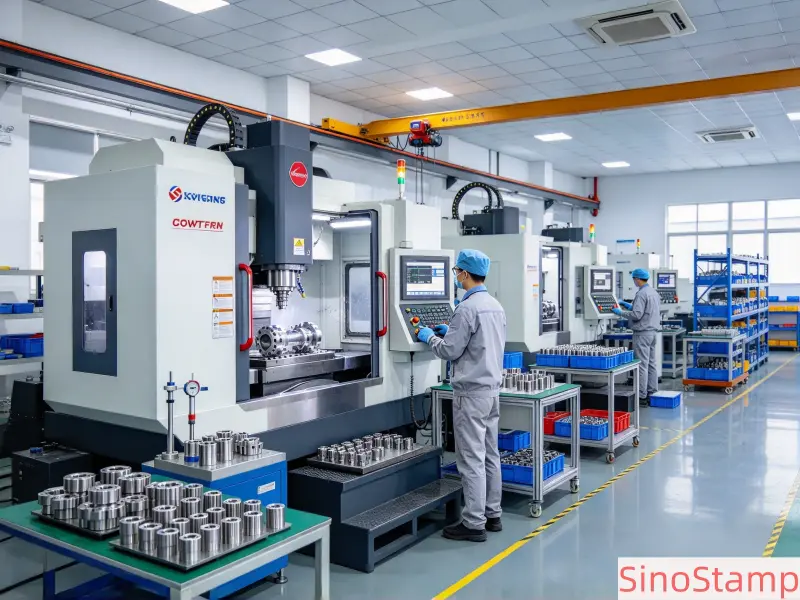
SinoStamp is a China-based supplier specializing in custom metal stamping parts for industrial manufacturers, electronics companies, electrical equipment producers, and home appliance brands. We provide OEM and ODM manufacturing services for customers looking for reliable metal components manufactured according to engineering drawings, technical specifications, samples, and project requirements. Our product range covers electronic metal stamping parts, electrical metal stamping parts, and home appliance metal stamping parts, supporting different applications that require accurate dimensions, consistent material properties, and dependable production quality.
As a custom metal stamping parts supplier, we understand that industrial buyers need more than a company capable of producing simple stamped components. They need a manufacturing partner that can understand technical drawings, evaluate material requirements, develop suitable tooling, control production processes, and maintain consistent quality across repeat orders. Our manufacturing approach focuses on practical engineering coordination, production feasibility, and long-term cooperation with OEM customers. Whether you are developing a new electronic device, sourcing connector components, or purchasing metal structural parts for household appliances, we can support your project from initial sample evaluation through regular production.
Custom metal stamping is an important manufacturing process for producing thin metal components with repeatable shapes and dimensions. By using dedicated stamping dies and mechanical or other suitable presses, sheet metal can be transformed into functional parts through operations such as blanking, piercing, bending, forming, and drawing. Depending on the product design, stamping can provide an economical solution for manufacturing small precision contacts, shielding covers, brackets, clips, mounting plates, and other metal components. Our objective is to help customers select appropriate manufacturing methods based on part geometry, material, dimensional requirements, order quantity, and expected product life cycle.
Different industries have different requirements for metal stamped components. Electronic products often require small parts with accurate geometry, electrical contact reliability, and effective shielding structures. Electrical equipment requires conductive terminals, contact components, and connector parts that can maintain stable mechanical and electrical performance. Home appliance manufacturers generally need practical structural components such as mounting brackets, internal support plates, frames, and fastening clips. To make product selection and sourcing more convenient, SinoStamp organizes its custom metal stamping products into three main application categories.
Electronic metal stamping parts are one of our primary product categories. These components are used in electronic devices, communication equipment, control systems, circuit assemblies, consumer electronics, and other products that require compact metal components. As electronic products become smaller and more integrated, manufacturers increasingly require stamped components with controlled dimensions, suitable material thicknesses, consistent forming quality, and reliable assembly compatibility. Metal stamping provides an efficient production solution for many of these applications.
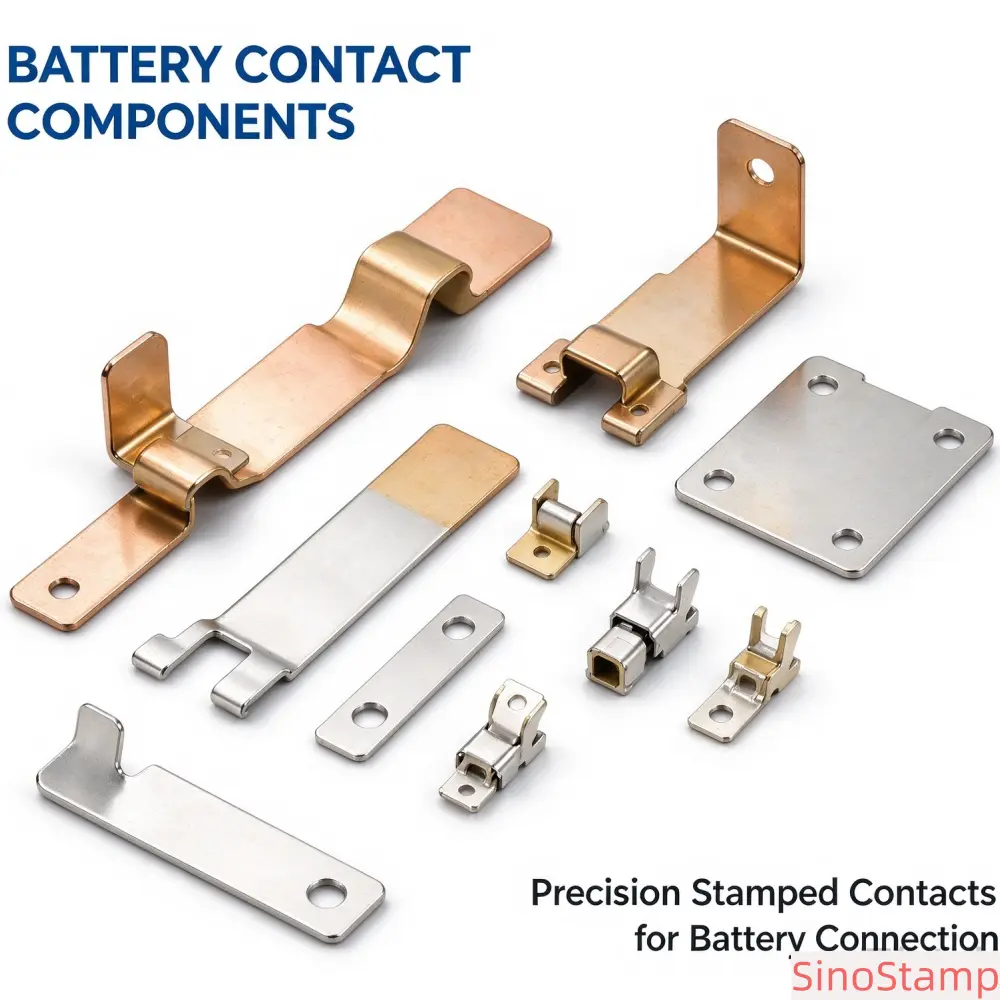
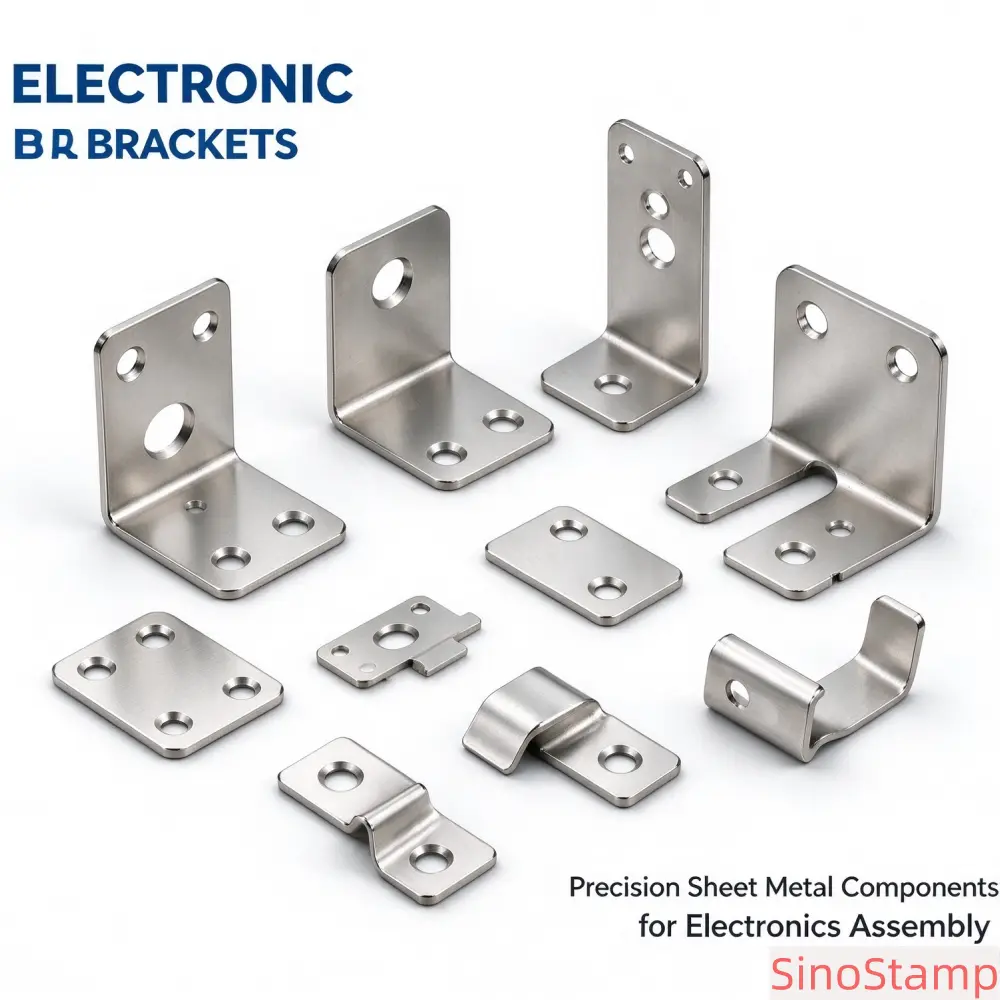
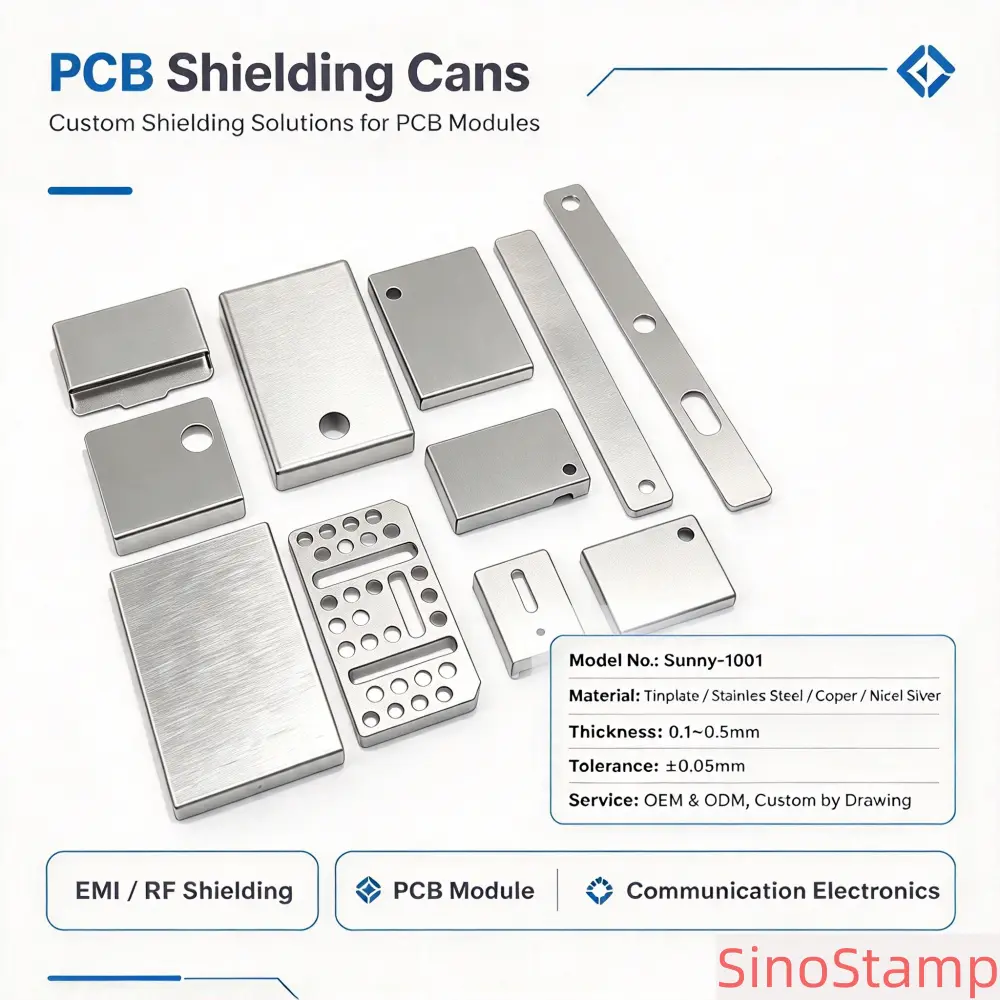
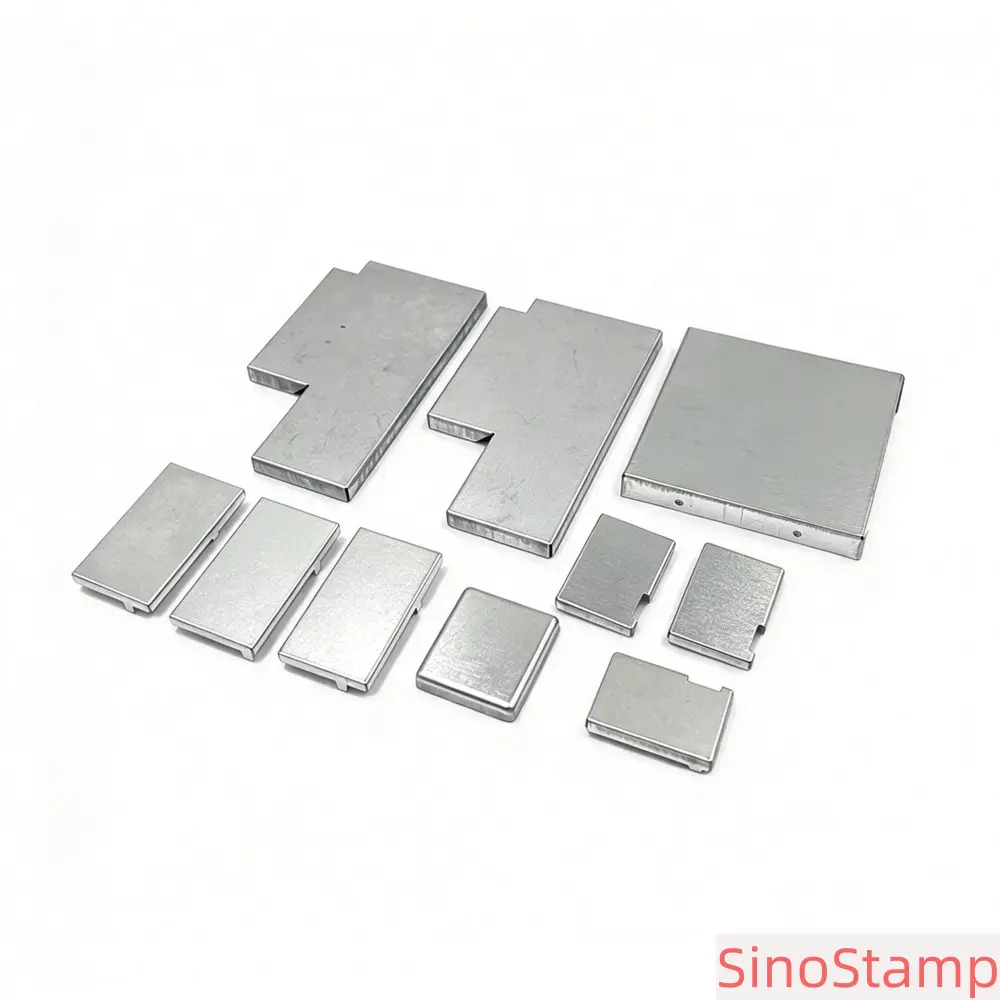
Our electronic metal stamping product range includes EMI shielding covers, PCB shielding cans, electronic metal brackets, battery contact components, and electronic spring contacts. These products can be manufactured according to customer drawings, samples, or agreed technical specifications. Depending on the application, materials may include stainless steel, copper, brass, phosphor bronze, and other suitable metal alloys. Material selection should consider electrical conductivity, mechanical strength, corrosion resistance, forming characteristics, and the final operating environment.
EMI shielding covers are metal components designed to help reduce electromagnetic interference within electronic equipment. They are commonly used in communication devices, wireless modules, circuit assemblies, control boards, and electronic systems containing sensitive components. A properly designed shielding cover can provide a conductive enclosure around selected circuit areas, helping limit electromagnetic coupling between components and reducing unwanted interference. The actual shielding effectiveness depends on several factors, including material conductivity, enclosure geometry, seams, openings, grounding arrangements, and installation conditions.
SinoStamp supports the manufacturing of custom EMI shielding covers according to customer drawings and application requirements. Common manufacturing considerations include material thickness, wall height, cover geometry, fastening structures, ventilation openings, and dimensional tolerances. Depending on the design, components may require blanking, piercing, bending, forming, and additional surface treatment. For products with special shielding requirements, engineers should evaluate the complete assembly, including the contact interface between the cover and the corresponding PCB or grounding structure.
When sourcing EMI shielding covers, OEM buyers should provide information about the electronic assembly, installation method, required material, and expected shielding performance. These details help determine a suitable metal construction and production process. For new projects, prototype samples can be used to evaluate fit, installation compatibility, and mechanical characteristics before finalizing production tooling.
PCB shielding cans are commonly installed on printed circuit boards to isolate sensitive electronic components or functional circuits. They are widely used in wireless communication modules, RF circuits, networking equipment, consumer electronics, and other compact electronic products. Depending on the design, a shielding can may consist of a metal frame, a removable cover, or an integrated stamped structure. Some designs use separate cover and frame components to make inspection, repair, and assembly easier.
Precision manufacturing is important for PCB shielding cans because small dimensional deviations can affect component clearance, PCB alignment, soldering compatibility, and cover installation. The height, width, wall structure, corner geometry, and contact areas must be considered during product development. Material thickness and forming conditions should also be selected to avoid excessive deformation or unwanted gaps in the finished component.
We support custom PCB shielding can projects based on engineering drawings, samples, and customer specifications. Depending on the product design, manufacturing may involve precision blanking, piercing, bending, forming, and surface finishing. Customers can discuss requirements for cover structure, frame configuration, material selection, and packaging during the quotation process. For repeat production, stable tooling and process control help maintain dimensional consistency between manufacturing batches.
Electronic metal brackets are used to support, position, secure, and connect different components inside electronic equipment. Typical applications include circuit board supports, internal mounting brackets, display assemblies, communication devices, control panels, and electronic enclosures. These components may have simple flat structures or more complicated geometries with multiple bends, mounting holes, slots, and positioning features.
Custom electronic metal brackets can be produced from stainless steel, carbon steel, aluminum, and other suitable materials depending on strength, weight, corrosion resistance, and application requirements. The manufacturing process may include cutting, blanking, piercing, bending, forming, deburring, and surface finishing. For components with several mounting features, accurate tooling design and dimensional inspection are important to ensure that the finished brackets fit the customer's assembly structure.
OEM customers can provide 2D drawings, 3D models, or physical samples for evaluation. We can review the proposed geometry and discuss practical production considerations, including bend positions, material thickness, hole locations, and forming feasibility. This engineering coordination is especially useful for customers developing new electronic products or transferring existing components to a new manufacturing supplier.
Battery contact components are metal parts used to establish electrical connections between batteries and electronic devices. They are found in battery holders, portable equipment, electronic accessories, control devices, and various battery-powered products. Depending on the design, battery contacts may be flat terminals, formed contact plates, spring-loaded structures, or specially shaped conductive components.
Material selection is particularly important for battery contact components because conductivity, elasticity, corrosion resistance, and contact stability can influence product performance. Copper alloys, brass, phosphor bronze, and other suitable conductive materials may be considered according to the electrical and mechanical requirements. Surface treatments such as nickel plating, tin plating, or other specified finishes may also be required to improve corrosion resistance or contact characteristics.
Our custom manufacturing service supports battery contact components produced according to customer drawings and samples. Important design factors include contact pressure, spring geometry, terminal dimensions, material thickness, mounting structure, and assembly compatibility. For products that require repeated insertion or removal of batteries, customers should also define the expected contact cycle and mechanical performance requirements so that the appropriate material and forming design can be evaluated.
Electronic spring contacts are stamped metal components designed to provide flexible electrical contact or mechanical connection within electronic assemblies. They are commonly used in connectors, battery systems, circuit boards, switches, communication equipment, and compact electronic devices. Their performance depends on material elasticity, contact geometry, forming accuracy, and the mechanical characteristics of the finished component.
Phosphor bronze, beryllium copper where permitted and appropriate, stainless steel, and other spring-grade metal materials may be considered for different applications. Material selection should account for conductivity, spring force, fatigue resistance, corrosion resistance, and operating conditions. The design of the spring section, including its length, thickness, curvature, and forming angle, can influence contact force and long-term reliability.
SinoStamp supports custom electronic spring contacts manufactured to customer specifications. During project evaluation, we consider the required spring structure, material properties, dimensional tolerances, and contact requirements. Prototype development and sample evaluation can help customers confirm mechanical fit and functional performance before proceeding with regular production.
Electrical metal stamping parts are used in electrical equipment, connectors, switches, power distribution products, control systems, and industrial electrical assemblies. Many of these components serve as conductive terminals or contact elements, meaning that their dimensional accuracy and material properties can directly influence the performance of the final electrical product. Compared with general structural stamped parts, electrical contact components often require more attention to conductivity, contact geometry, surface condition, and assembly consistency.
Our electrical metal stamping range focuses on copper terminal stamping, electrical contact stamping, connector terminals, and switch contacts. These components can be manufactured using suitable conductive metals and alloys based on the customer's application requirements. Production methods may include precision blanking, piercing, bending, forming, and secondary finishing. Depending on the design and order volume, customers can discuss prototype tooling, dedicated production tooling, and suitable manufacturing arrangements.
Copper terminal stamping is an important manufacturing process for producing conductive terminals used in electrical and electronic assemblies. Copper and copper alloys are widely selected for their electrical conductivity, formability, and suitability for various connection structures. Typical applications include wiring terminals, electrical connectors, battery connections, power equipment, control panels, and industrial electrical products.
Custom copper terminals may include flat terminals, tab terminals, bent terminals, mounting terminals, and specially formed connection components. Their geometry can incorporate holes, slots, contact surfaces, locking structures, and mounting features. Depending on the required electrical and mechanical properties, materials may include copper, brass, phosphor bronze, or other specified copper alloys.
For OEM projects, it is important to define material grade, thickness, conductivity requirements, plating specifications, and dimensional tolerances before production. The stamping process should maintain stable terminal geometry and avoid burrs or deformation that could affect electrical connections or assembly operations. We work with customers to evaluate these requirements and manufacture copper terminal stamping parts according to approved drawings and specifications.
Electrical contact stamping involves producing metal components that establish, maintain, or interrupt electrical connections. These components are used in relays, switches, electrical connectors, control equipment, power devices, and industrial electrical assemblies. Depending on the application, contact components may be manufactured from copper alloys, brass, phosphor bronze, stainless steel, or other suitable materials.
Electrical contact performance is influenced by several factors, including material conductivity, contact area, surface condition, contact pressure, temperature, and operating environment. Some designs require plating or other surface treatments to improve corrosion resistance, reduce contact resistance, or provide specific functional characteristics. The selection of material and finishing process should be based on the actual electrical requirements of the finished product.
SinoStamp supports custom electrical contact stamping projects based on customer drawings and samples. Our manufacturing considerations include part geometry, material thickness, hole positions, contact surfaces, forming requirements, and secondary operations. For components used in repeated switching applications, customers should provide relevant electrical and mechanical specifications so that the manufacturing design can be evaluated appropriately.
Connector terminals are essential metal components used to establish electrical connections between cables, circuit boards, devices, and electrical systems. They are widely used in automotive electronics, industrial controls, communication equipment, consumer electronics, and power distribution products. Depending on the connector design, terminals may include pin structures, blade terminals, receptacle contacts, crimp terminals, and custom-shaped conductive parts.
Precision connector terminals often require controlled dimensions, consistent contact geometry, suitable material hardness, and reliable surface finishing. Copper alloys are frequently used because of their conductivity and forming characteristics. Additional requirements may include tin plating, nickel plating, silver plating, or other specified surface treatments depending on the operating environment and connection requirements.
Our custom connector terminal manufacturing service is intended for OEM customers requiring parts based on technical drawings or approved samples. We can support discussion of material specifications, terminal thickness, stamping geometry, contact areas, and secondary operations. For products involving crimping or insertion into connector housings, the dimensional relationship between the terminal and its mating components should be carefully reviewed before production tooling is finalized.
Switch contacts are metal components that help establish or interrupt electrical circuits when a switch is operated. They are used in household electrical appliances, industrial control devices, electronic switches, power control systems, and various switching assemblies. Depending on the product structure, switch contacts may be flat contact plates, spring contacts, formed terminals, or specially designed conductive components.
Switch contact manufacturing requires attention to material selection, contact geometry, surface quality, and dimensional stability. Different products may require copper alloys, brass, phosphor bronze, or other specified materials. Some applications also require contact materials or surface treatments designed to meet particular electrical endurance, wear, or corrosion requirements. The final material and finish should always be determined by the customer's product specifications and testing requirements.
For custom switch contacts, SinoStamp supports manufacturing according to customer drawings, samples, and technical documentation. Important considerations include contact position, operating clearance, material thickness, mounting method, and forming geometry. Consistent production control is important for maintaining repeatable component dimensions and supporting the assembly requirements of electrical switch manufacturers.
Home appliance metal stamping parts are widely used in household equipment such as washing machines, refrigerators, air conditioners, kitchen appliances, water heaters, ventilation equipment, and other domestic electrical products. These components provide structural support, mounting functions, internal positioning, motor installation, and mechanical fastening. Compared with some highly specialized electronic components, many appliance stamping parts have more straightforward geometries, making them suitable for efficient production through conventional stamping and forming processes.
Our home appliance metal stamping product range includes appliance mounting brackets, metal frames, internal support plates, motor mounting components, and metal fastening clips. These parts can be manufactured according to customer drawings and application requirements, with material selection based on mechanical strength, corrosion resistance, weight, cost, and operating environment. Depending on the product design, secondary processes may include deburring, tapping, welding, plating, coating, and other specified finishing operations.
Appliance mounting brackets are structural metal components used to install, position, and secure different assemblies inside or outside household equipment. Typical applications include compressor supports, control panel brackets, motor supports, electrical enclosure brackets, and mounting structures for internal appliance components. These products may have flat or multi-bend structures with mounting holes, slots, tabs, and reinforcement features.
Custom appliance mounting brackets can be produced from carbon steel, stainless steel, galvanized steel, aluminum, and other suitable materials. The appropriate material depends on load requirements, corrosion exposure, operating temperature, product weight, and cost considerations. For components used in vibration-prone environments, the design should also consider structural stiffness, mounting security, and the effect of repeated mechanical loading.
SinoStamp supports OEM appliance mounting bracket projects from drawing review and sample evaluation to tooling development and production. Customers can provide dimensional drawings, 3D models, or existing samples for quotation. Our manufacturing evaluation considers material thickness, bend geometry, hole positions, dimensional tolerances, and the feasibility of the proposed production process.
Metal frames are used to provide structural support and maintain the positioning of assemblies in household appliances and industrial equipment. They can serve as internal equipment frames, mounting structures, enclosure supports, reinforcement components, or connection structures between different product sections. Depending on the application, metal frames may consist of stamped sheet metal sections, formed plates, brackets, and assembled components.
Manufacturing requirements vary according to frame size, geometry, material thickness, and structural function. Some products can be produced using simple blanking and bending operations, while more complicated designs may require multiple stamping operations, welding, or assembly. Dimensional consistency is important because the frame often serves as a reference structure for installing other components.
We support custom metal frame manufacturing according to OEM drawings and technical specifications. During project review, customers should provide information about mounting points, load requirements, dimensional tolerances, material grade, surface finish, and assembly conditions. This information helps establish a suitable manufacturing process and reduce unnecessary adjustments during later production stages.
Internal support plates are stamped metal components used to reinforce structures, support electrical assemblies, position internal parts, and distribute mechanical loads inside household appliances. They are commonly found in refrigerators, washing machines, air conditioners, kitchen appliances, and other equipment. Their geometry may include mounting holes, slots, raised sections, bends, and other features designed for specific installation purposes.
These components are often manufactured from cold-rolled steel, galvanized steel, stainless steel, aluminum, or other materials selected according to strength, corrosion resistance, and cost requirements. The manufacturing process may involve blanking, piercing, bending, forming, and deburring. For products requiring accurate positioning of internal assemblies, hole location and flatness should be controlled according to the customer's specifications.
Our custom internal support plate service helps appliance manufacturers source components that match their assembly designs. Customers can provide technical drawings or samples for manufacturing evaluation. We can discuss material thickness, forming requirements, dimensional inspection, and finishing specifications to support a practical production solution for the project.
Motor mounting components are used to secure electric motors within household appliances and industrial equipment. They may include motor brackets, mounting plates, formed support structures, retaining components, and related stamped metal parts. These components are important for maintaining motor positioning and supporting the mechanical structure during equipment operation.
Motor mounting designs should consider motor dimensions, mounting hole locations, load distribution, vibration, operating temperature, and installation space. Depending on the product requirements, components may be manufactured from carbon steel, stainless steel, galvanized steel, or aluminum. Reinforcement bends, ribs, and formed sections may be incorporated to improve structural stiffness without unnecessarily increasing material thickness.
SinoStamp supports custom motor mounting component manufacturing for appliance and equipment OEM customers. We evaluate customer drawings and samples to understand the required geometry, material, dimensional tolerances, and production process. For projects involving vibration or mechanical loading, customers should provide relevant application specifications to support the manufacturing and engineering review.
Metal fastening clips are small stamped components used to hold, secure, position, or connect parts within appliance assemblies. They are commonly used in electrical enclosures, internal panel structures, cable management systems, covers, housings, and mechanical assemblies. Their designs can include spring tabs, retaining hooks, locking sections, and other formed features that allow components to be installed and secured efficiently.
Depending on the application, fastening clips may be produced from stainless steel, carbon steel, spring steel, or suitable copper alloys. Material selection should consider required spring characteristics, corrosion resistance, thickness, installation force, and expected service conditions. Forming accuracy is particularly important for clips with flexible sections because variations in geometry can affect retention force and assembly compatibility.
We manufacture custom metal fastening clips based on customer specifications and application requirements. During quotation and development, it is useful to provide information about the mating components, installation direction, retention requirements, material grade, and expected mechanical performance. These details help determine an appropriate stamped structure and production method.
Custom metal stamping involves more than selecting a press and producing a metal shape. Successful manufacturing requires coordination between product geometry, material characteristics, tooling design, press capability, process sequence, and inspection requirements. SinoStamp works with OEM customers to evaluate these factors before production begins, helping establish a manufacturing approach that is practical for the intended application and order volume.
Depending on the part design, manufacturing processes may include blanking, piercing, bending, forming, drawing, and progressive die stamping. Simple components may be suitable for single-operation or compound tooling, while more complex parts may require multiple forming stages. The appropriate process depends on geometry, material thickness, dimensional requirements, production volume, and tooling investment considerations.
Blanking and piercing are fundamental metal stamping operations used to create the external shape and internal features of stamped components. Blanking separates the required component from a sheet or coil of metal, while piercing creates holes, slots, and other openings. These operations are widely used for electronic shielding covers, electrical terminals, mounting brackets, support plates, and many other stamped parts.
Tooling clearance, material thickness, material hardness, and cutting edge condition can influence burr formation and dimensional consistency. For components with critical hole positions or contact areas, the tooling design and inspection method should be established according to the customer's drawing requirements. Appropriate deburring or additional finishing may also be required depending on the final assembly and handling conditions.
Bending and forming operations are used to create three-dimensional features from flat sheet metal. They are essential for producing brackets, clips, shielding covers, terminals, frames, and structural support components. Different products may require simple right-angle bends, multiple bends, formed tabs, curved sections, or more complicated shapes.
Material properties, thickness, bend radius, grain direction, and springback can affect the final geometry. These factors should be considered during product design and tooling development. For parts with multiple forming features, the sequence of operations can influence dimensional accuracy and production stability. Engineering review before tooling production can help identify potential forming challenges and improve manufacturing feasibility.
Progressive die stamping is suitable for manufacturing certain metal components in repeated production quantities. In this process, metal strip material passes through a series of stations within a progressive die. Each station performs a specific operation, such as piercing, blanking, bending, or forming, until the finished part is produced. This process can provide efficient production for suitable component designs with consistent geometry and repeat demand.
Progressive tooling may be considered for electronic contacts, connector terminals, clips, small brackets, and other components with a suitable strip layout. The feasibility of progressive die production depends on part geometry, material properties, strip utilization, production volume, and tooling cost. For smaller or less frequent orders, alternative tooling arrangements may be more economical. We evaluate project requirements to help customers consider the appropriate manufacturing approach.
Tooling is a key factor in the quality, repeatability, and production efficiency of custom metal stamping parts. A stamping die must be designed according to the component geometry, material thickness, required operations, and production conditions. Depending on the design, tooling may involve blanking dies, piercing dies, bending dies, compound dies, or progressive dies.
For new OEM projects, customers can provide 2D engineering drawings, 3D CAD files, or physical samples. These documents help manufacturers understand the component structure and evaluate tooling requirements. Before production tooling is finalized, important factors include material grade, dimensional tolerances, critical features, production quantity, and inspection standards. Clear communication during the development stage can help reduce design changes and improve the transition from prototype samples to regular production.
Material selection has a direct influence on the mechanical, electrical, forming, and environmental performance of metal stamped components. Different applications require different combinations of strength, conductivity, corrosion resistance, elasticity, weight, and manufacturing cost. SinoStamp supports discussions of material options according to customer drawings and project specifications, with the final material grade and thickness determined by the approved technical requirements.
Stainless steel is commonly used for components requiring corrosion resistance, mechanical strength, and stable performance in demanding environments. It can be suitable for shielding covers, support brackets, clips, appliance components, and various structural parts. Different stainless steel grades have different mechanical and forming characteristics, so the grade should be selected according to the intended application rather than appearance alone.
Carbon steel and cold-rolled steel are widely used for brackets, frames, support plates, mounting components, and other structural stamped parts. They provide practical mechanical properties and can be suitable for applications where strength and manufacturing cost are important considerations. Depending on the operating environment, surface treatments such as plating, coating, or painting may be specified to improve corrosion protection and appearance.
Copper and copper alloys are frequently selected for electrical and electronic components because of their conductivity and forming characteristics. Applications include copper terminals, connector contacts, battery contacts, electrical contact plates, and electronic spring components. Brass and phosphor bronze are common material options for certain conductive and spring applications. The appropriate alloy depends on conductivity, hardness, elasticity, contact requirements, and the final component geometry.
Aluminum is used in applications where low weight, corrosion resistance, and suitable formability are important. It can be considered for electronic brackets, equipment support plates, structural components, and selected appliance parts. Different aluminum alloys have different strength and forming properties, so material selection should consider the required geometry, thickness, and operating conditions.
Material thickness influences component strength, forming behavior, finished dimensions, and production feasibility. The suitable thickness depends on the part design, load requirements, available installation space, and manufacturing process. For accurate quotation and production planning, OEM customers should specify the material grade and thickness on their engineering drawings whenever possible. If material specifications have not yet been finalized, the application and performance requirements can be discussed during the initial project evaluation.
Many custom metal stamping parts require additional processing after the primary stamping operation. Secondary operations may be necessary to achieve final dimensions, improve surface condition, provide corrosion protection, or prepare components for assembly. The required finishing process depends on material type, product function, customer specifications, and the intended operating environment.
Deburring is used to remove or reduce unwanted sharp edges and burrs created during cutting and stamping. It is particularly important for components that require safe handling, close assembly clearances, or reliable electrical contact. The acceptable burr condition should be defined according to the part drawing and application requirements.
Surface finishing options may include nickel plating, tin plating, zinc plating, and other specified treatments. These processes can provide different combinations of corrosion protection, surface appearance, solderability, or electrical contact characteristics. For conductive components, the selected finish should be evaluated against the required electrical and environmental performance. Customers should specify coating type, thickness, coverage, and any relevant testing requirements.
Some metal stamping projects require additional manufacturing operations such as tapping, spot welding, riveting, or component assembly. These processes can help create finished subassemblies that are easier for OEM customers to install in their products. The availability and suitability of each secondary process should be confirmed during project evaluation according to the part design and production requirements.
Custom metal stamping parts are used in a wide range of industrial and commercial products. Their applications include electrical connections, structural support, electromagnetic shielding, mechanical positioning, fastening, and enclosure construction. By organizing our product range around electronics, electrical equipment, and home appliances, SinoStamp aims to support customers with different component sourcing requirements while maintaining a clear focus on custom OEM manufacturing.
Electronic metal stamped components are used in communication devices, networking equipment, wireless modules, computer hardware, electronic control systems, and consumer electronics. Shielding covers and PCB shielding cans help provide metal enclosure structures around selected circuits. Brackets and support components help secure internal assemblies, while battery contacts and spring contacts provide electrical connection functions. These applications often require compact dimensions and controlled component geometry.
Electrical metal stamping components are used in connectors, switches, control equipment, power distribution assemblies, and industrial electrical products. Copper terminals, electrical contact plates, and connector terminals provide conductive connection structures. Their manufacturing requirements may include specific material grades, surface finishes, contact dimensions, and forming characteristics. Consistent component quality is important for maintaining compatibility with the customer's electrical assembly process.
Household appliance manufacturers use stamped metal components in both internal structures and external mounting assemblies. Brackets, metal frames, support plates, motor mounting components, and fastening clips help secure different parts and maintain product structure. These components may be produced in repeat quantities for appliance assembly lines, making production consistency, material availability, and reliable delivery important considerations for sourcing teams.
In addition to the three main product categories, custom stamped components can also be used in industrial equipment, mechanical assemblies, control cabinets, and related applications. Brackets, mounting plates, clips, and formed sheet metal components are frequently incorporated into equipment structures. Where product designs overlap with our existing manufacturing capabilities, OEM customers can discuss custom component requirements for evaluation.
SinoStamp focuses on B2B manufacturing cooperation with companies that require custom metal components rather than only standard off-the-shelf products. Our OEM service supports customers who already have established drawings, material specifications, and product designs. Manufacturing can be arranged according to approved technical documents, samples, and agreed quality requirements.
For ODM-related projects, customers may need support during the early stages of product development. This may include reviewing part geometry, discussing material options, evaluating stamping feasibility, and coordinating tooling requirements. The exact scope of engineering support depends on project complexity and the information available from the customer. Our goal is to help establish a workable manufacturing solution before regular production begins.
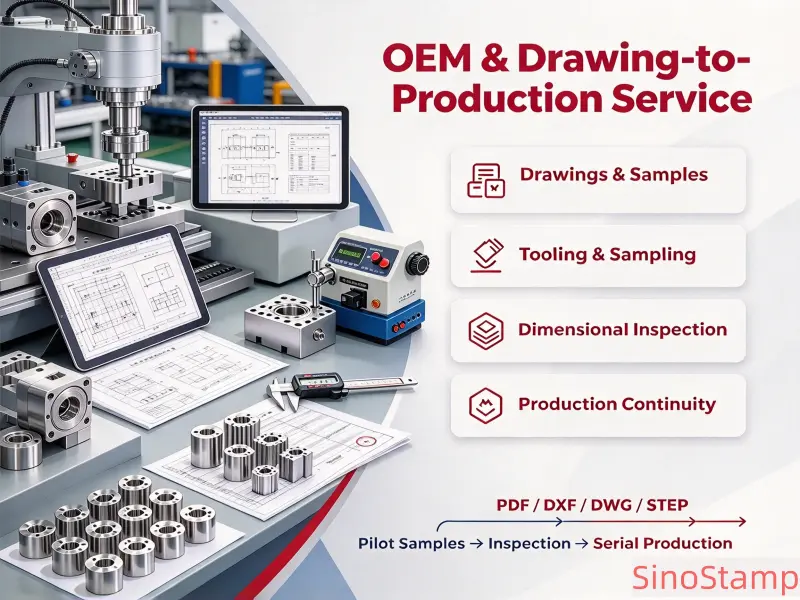
Engineering drawings are one of the most important documents for custom metal stamping projects. They define dimensions, tolerances, material specifications, surface finishing requirements, and critical product features. Customers can provide PDF drawings, 2D CAD files, 3D models, or other technical documentation for initial evaluation. Clear drawings help reduce misunderstandings during quotation, tooling development, sample approval, and mass production.
Prototype samples allow customers to evaluate the physical structure and manufacturing feasibility of a new component before committing to regular production. Depending on project requirements, samples may be produced using suitable prototype tooling or an agreed alternative manufacturing method. Sample evaluation can include dimensional verification, assembly fit, material confirmation, surface condition, and other characteristics defined by the customer.
For electronic and electrical components, additional functional evaluation may be required according to the product application. For example, customers may need to assess contact characteristics, installation compatibility, spring behavior, or shielding performance at the assembly level. These requirements should be discussed during the project development stage so that appropriate inspection and validation arrangements can be established.
Not every OEM project begins with large production quantities. New product launches, engineering validation, market testing, and specialized equipment projects may require smaller initial orders. SinoStamp welcomes inquiries for suitable small-batch and medium-volume manufacturing projects, with production arrangements evaluated according to part complexity, tooling requirements, material availability, and order quantity.
For customers with recurring demand, the manufacturing process can be planned around approved drawings, established tooling, defined inspection requirements, and repeat order specifications. Long-term production cooperation requires clear communication regarding forecast quantities, order schedules, quality expectations, and any engineering changes. Our aim is to support practical supply arrangements for both initial development and ongoing procurement.
Quality control is essential for custom metal stamping because small variations in material thickness, tooling condition, forming geometry, and production settings can affect the finished component. A consistent quality system should consider incoming material, production processes, dimensional inspection, surface condition, and final product verification. Inspection requirements should be agreed with customers according to the critical characteristics of each part.
Material verification is an important starting point for production quality. Relevant checks may include material grade, thickness, surface condition, and supporting material documentation where required. For electrical and electronic components, material specifications can be particularly important because conductivity, hardness, and mechanical properties influence component performance.
Dimensional inspection helps verify that finished components conform to approved engineering drawings. Depending on the part, inspection may include overall dimensions, hole diameters, hole positions, bend angles, forming heights, flatness, and other critical features. Measurement methods should be appropriate for the component geometry and the customer's specified tolerances.
Monitoring production conditions helps identify dimensional variation and other potential quality issues. Relevant factors may include tooling condition, press settings, material feeding, forming consistency, and the condition of critical die features. For repeat production, process records and inspection arrangements can help maintain consistency between batches and support continuous improvement.
Final inspection may include dimensional checks, visual inspection, surface condition verification, burr assessment, and quantity confirmation. Packaging should be selected according to component size, shape, surface finish, and transportation requirements. Small precision stamped parts may require protective packaging to reduce scratching, deformation, or mixing during handling and shipment. Customers can communicate labeling, packing quantity, and packaging specifications during order confirmation.
Selecting a metal stamping supplier is an important decision for OEM purchasing teams because component quality, manufacturing cost, lead time, and supplier communication all influence the customer's production schedule. SinoStamp focuses on custom manufacturing projects where technical requirements and production consistency are important. We work with customers to understand their drawings, product applications, material specifications, and sourcing expectations before proposing a manufacturing arrangement.
Our product structure focuses on electronic metal stamping parts, electrical metal stamping parts, and home appliance metal stamping parts. This organization reflects the different applications and purchasing requirements of these industries. It also helps customers identify relevant component types more efficiently when discussing custom manufacturing projects.
We support custom components produced according to customer drawings, specifications, and approved samples. This approach allows OEM customers to source parts that match their existing product designs rather than adapting their assemblies around standard components. Material, dimensions, forming features, and finishing requirements can be evaluated according to each project's technical documentation.
Tooling selection and production planning are closely related to product geometry and order quantity. A suitable manufacturing arrangement can help balance tooling investment, production efficiency, and component quality. We encourage customers to share technical drawings and expected order volumes so that tooling and process requirements can be reviewed before a quotation is finalized.
We understand that overseas procurement teams need clear communication, reliable technical information, and predictable order coordination. During project discussions, customers can confirm product specifications, material requirements, samples, tooling arrangements, inspection criteria, packaging, and shipping details. Clear agreement on these points helps reduce sourcing uncertainty and supports long-term cooperation between manufacturers and international buyers.
Starting a custom metal stamping project is easier when the customer provides complete technical and purchasing information. The initial information normally includes product drawings, material requirements, thickness, expected order quantity, surface finish, dimensional tolerances, and intended application. If drawings are not available, physical samples or reference photographs may help explain the required component structure, although complete engineering specifications are preferable for accurate quotation and production.
After receiving the project information, the manufacturing requirements can be reviewed to identify suitable materials, stamping operations, tooling arrangements, and potential secondary processes. If the design requires clarification, customers and the supplier can discuss critical dimensions, forming features, assembly conditions, and inspection expectations. This review helps establish a clearer technical basis for quotation and sample development.
For new projects, sample evaluation is an important stage before regular production. Customers can inspect the samples against approved drawings and evaluate fit, appearance, and other specified performance requirements. Once samples and manufacturing details are approved, the project can move toward regular production according to the agreed order schedule and quality requirements.
To prepare a practical quotation for custom metal stamping parts, we recommend that customers provide as much of the following information as possible:
Complete project information helps reduce assumptions during quotation and allows manufacturing requirements to be evaluated more accurately. If some specifications are still under development, customers can identify the confirmed requirements and the items that need further discussion. This is especially useful for new OEM products that have not yet completed their design validation stage.
For many industrial buyers, sourcing custom metal stamping parts is not a one-time purchasing activity. Electronic devices, electrical assemblies, and home appliances often require recurring components throughout their production life cycles. A dependable supplier relationship therefore involves more than the first sample or initial production order. It requires consistent technical documentation, stable manufacturing processes, clear communication, and coordination of repeat orders.
SinoStamp aims to establish long-term B2B cooperation with manufacturers and sourcing companies that need customized metal components. Whether your project involves EMI shielding covers, PCB shielding cans, copper terminals, connector contacts, appliance brackets, or other stamped parts, we welcome opportunities to review your requirements and discuss suitable manufacturing solutions.
If you are looking for a China-based metal stamping parts manufacturer for an existing product or a new OEM development project, you can send us your drawings, samples, or technical specifications for evaluation. Our team can review the component structure, material requirements, production quantity, and manufacturing considerations to help determine the next steps for sampling, tooling, and production.
```