Progressive Die Stamping vs. Single-Stage Stamping: Which Is Better for OEM Metal Parts?
Choosing the right metal stamping process is an important decision for OEM manufacturers developing custom metal components. The production method affects tooling investment, manufacturing efficiency, dimensional consistency, unit cost, and the ability to support different order quantities.
Two commonly used approaches in metal stamping are progressive die stamping and single-stage stamping. Both processes use dedicated tooling and mechanical or servo stamping presses to transform flat metal sheets or coils into functional components. However, they differ significantly in tooling structure, production sequence, automation requirements, and economic suitability.
Progressive die stamping is generally associated with continuous production, where a metal strip moves through multiple stations within one die. Each station performs a specific operation until the finished component is produced. Single-stage stamping uses a simpler production arrangement in which a particular operation is completed in one press stroke. Depending on the part design, multiple single-operation dies may be used in sequence to complete a component.
For OEM buyers, neither process is automatically better in every situation. The right choice depends on part geometry, material thickness, dimensional requirements, annual demand, tooling budget, and expected product life cycle.
This guide explains the differences between progressive die stamping and single-stage stamping, compares their advantages and limitations, and provides practical recommendations for selecting a suitable manufacturing method for custom metal stamping projects.
1. What Is Progressive Die Stamping?
Progressive die stamping is a metal forming process that uses a specially designed die containing multiple working stations. A metal strip is fed through the die in a controlled sequence, and each station performs one or more operations as the press moves through its strokes.
These operations may include blanking, punching, notching, bending, forming, and other shaping processes. As the strip advances through the die, the component gradually takes its final shape. Once the strip reaches the final station, the completed part is separated from the carrier strip.
Unlike a process that requires an operator to manually transfer individual blanks between several separate dies, progressive die stamping integrates multiple operations into one production system. This makes it suitable for manufacturing large quantities of consistent metal components.
How Does Progressive Die Stamping Work?
A typical progressive die stamping process involves several stages:
- Coil Preparation: Metal coil is prepared according to the required material grade, thickness, and width.
- Material Feeding: A feeding system moves the metal strip into the stamping press at a controlled distance.
- First Station: The die performs an initial operation, such as punching a hole or creating a notch.
- Intermediate Stations: Additional stations perform cutting, bending, forming, or other required operations.
- Final Station: The finished component is separated from the remaining carrier material.
- Part Collection: Completed parts are collected for inspection, secondary processing, and packaging.
Each press stroke advances the strip through the die according to a predetermined feed pitch. After the initial setup and filling of the stations, multiple stages of the component's manufacturing sequence are performed during each press cycle.
The exact number of stations depends on the component's geometry and the required manufacturing operations. A simple stamped terminal may require relatively few stations, while a more complex component may need a longer sequence of cutting and forming operations.
Common Features of Progressive Die Stamping
Progressive die stamping is characterized by continuous material feeding, multiple integrated operations, dedicated tooling, and repeatable production cycles. It is particularly useful when a component has a stable design and is required in substantial quantities.
Typical applications include electrical terminals, connector contacts, electronic shielding components, spring contacts, battery contacts, metal clips, and other precision stamped parts.
For OEM manufacturers, the main attraction is the ability to combine several manufacturing operations into an efficient production process. Once the tooling has been developed and properly adjusted, progressive stamping can support high output with limited manual handling between operations.
2. What Is Single-Stage Stamping?
Single-stage stamping refers to a production approach in which one main stamping operation is completed in a dedicated die during a press stroke. The operation may involve blanking, punching, bending, or another specific forming task.
For example, a simple metal plate may be produced using a blanking die, while a metal bracket may require a separate bending operation after the initial blank has been cut.
Depending on the component design, several single-stage dies can be used sequentially to complete the final part. In this arrangement, each die performs a defined operation, and the workpiece is transferred to the next process as required.
How Does Single-Stage Stamping Work?
A typical single-stage stamping workflow may include the following steps:
- Material Preparation: Metal sheets, strips, or pre-cut blanks are prepared for processing.
- Blank Loading: The material or workpiece is positioned in the stamping die.
- Stamping Operation: The press performs the required cutting, punching, bending, or forming operation.
- Part Removal: The processed component is removed from the die.
- Next Operation: If the component requires additional processing, it is transferred to another die or production station.
- Inspection: The finished part is checked against the drawing and quality requirements.
For simpler components, one operation may be sufficient to produce the finished part. More complicated components may require several separate dies and additional handling between processes.
Common Features of Single-Stage Stamping
Single-stage stamping generally involves simpler tooling compared with a multi-station progressive die. It can be suitable for prototypes, small production runs, simpler components, and projects where the final design is not yet fully established.
Because each operation is handled separately, the manufacturer can adjust individual process steps without necessarily modifying a complete progressive die system. This may provide flexibility during early product development or when a component has relatively low production demand.
However, when multiple operations are required, the total production process may involve more handling, additional setup time, and greater dependence on operator or transfer arrangements.
3. Key Differences Between Progressive Die Stamping and Single-Stage Stamping
Both manufacturing methods can produce custom metal components, but they are designed for different production conditions. Understanding the main differences helps OEM buyers select a process that matches their technical and commercial requirements.
| Comparison Factor | Progressive Die Stamping | Single-Stage Stamping |
|---|---|---|
| Production Structure | Multiple operations integrated into one progressive die | One main operation per die |
| Material Feeding | Usually continuous strip or coil feeding | Sheets, strips, or individual blanks depending on the setup |
| Tooling Complexity | Generally more complex | Generally simpler for each operation |
| Initial Tooling Investment | Often higher | Often lower for simple parts |
| Production Efficiency | High after setup and process stabilization | Depends on the number of operations and handling requirements |
| Manual Handling | Can be reduced through automated feeding | May require handling or transfer between operations |
| Small-Batch Suitability | Depends on tooling cost and project economics | Often suitable for simple parts and lower quantities |
| High-Volume Suitability | Often suitable for stable, high-volume demand | Can be suitable, but may require more production resources |
| Design Changes | Changes may require modifications to integrated tooling | Individual operations may be easier to adjust |
| Part Complexity | Can support complex multi-operation components | Can support complex parts through multiple separate operations |
These comparisons are general manufacturing tendencies rather than fixed rules. The actual result depends on part design, production equipment, automation, material characteristics, tooling engineering, and order quantity.
4. Tooling Investment: Which Process Requires More Initial Cost?
Tooling investment is often one of the first concerns for OEM buyers developing custom stamped components. The difference between progressive and single-stage stamping can be significant, particularly when the project involves complex part geometry or dedicated tooling.
Progressive Die Tooling Costs
A progressive die integrates multiple operations into one tooling system. It may require several stations, precision alignment, material feeding coordination, strip layout engineering, and careful adjustment of the working components.
Because of this complexity, progressive die tooling often requires a higher initial investment than a simple single-stage die.
However, the higher tooling cost may be justified when the component is required in large quantities. The production system can reduce manual handling and improve output efficiency after the die has been developed and stabilized.
For OEM projects with long product life cycles and recurring orders, the tooling investment can be distributed across a larger number of parts. This may result in a lower unit cost over time.
Single-Stage Tooling Costs
Single-stage dies are often simpler because each tool is designed for one main operation. For a straightforward blanking or punching project, the initial tooling investment may be relatively economical.
This can make single-stage stamping attractive for prototype development, low-volume production, or components that do not justify a complex integrated die.
However, if a component requires several operations, the buyer may need to pay for multiple dies. The combined tooling investment should therefore be compared with the cost of a progressive die rather than evaluating each individual die in isolation.
What Should OEM Buyers Ask About Tooling?
Before confirming a tooling order, buyers should request clear information about:
- Tooling design and development charges.
- Number of operations or stations included.
- Expected tooling development schedule.
- Trial stamping and sample submission arrangements.
- Tooling maintenance requirements.
- Expected tooling service life under defined operating conditions.
- Ownership and storage responsibilities.
- Modification costs if the engineering design changes.
It is also important to clarify whether tooling charges include engineering work, trial production, adjustments, and initial sample inspection. A detailed quotation makes supplier comparisons more reliable.
5. Production Efficiency and Manufacturing Output
Production efficiency is another major difference between the two processes. The number of operations required, material feeding method, handling requirements, press speed, and tooling stability all influence manufacturing output.
Efficiency of Progressive Die Stamping
Progressive die stamping can achieve high production output because several operations are performed within one integrated tooling system. After the strip reaches the final station, each press cycle can produce a completed part while other sections of the strip are being processed at earlier stations.
Automatic feeding systems can reduce manual material handling and improve production consistency. This is particularly useful for small components that are required in large quantities.
However, actual output depends on the component design, die structure, press capacity, material properties, and inspection requirements. A complex progressive die may require careful setup and process monitoring before stable production can be achieved.
Efficiency of Single-Stage Stamping
Single-stage stamping can be efficient when a part requires only one simple operation. A straightforward blanking process, for example, may produce components quickly without requiring a complex multi-station die.
When several operations are needed, however, the manufacturer may need to transfer components between dies. Additional loading, unloading, positioning, and inspection can increase the total processing time.
Automation and dedicated transfer systems can improve the efficiency of multi-stage production, but these arrangements need to be evaluated as part of the complete manufacturing solution.
For OEM buyers, the most useful comparison is not simply the press speed. It is the total time and cost required to produce an accepted finished component, including setup, handling, inspection, secondary processing, and scrap management.
6. Which Process Is More Suitable for Small-Batch Production?
Small-batch production is common among small and medium-sized OEM companies, particularly during product development, market introduction, and early commercial production.
For projects with relatively low demand, single-stage stamping may offer a practical solution because simple dies can often be developed with a lower initial investment. It can also be useful when the product design is still changing and the manufacturer needs to adjust individual operations.
However, single-stage stamping is not automatically the best option for every small-batch project. If the component requires many separate operations, the combined tooling costs and production handling may become substantial.
Progressive die stamping can also be considered for lower-volume projects when the component has a stable design, the tooling cost is commercially acceptable, or future demand is expected to increase significantly.
Factors to Consider for Small Orders
- Expected order quantity for each production run.
- Forecasted annual demand rather than only the first order.
- Number of required stamping operations.
- Tooling investment and expected product life cycle.
- Whether the component design is finalized.
- Secondary processing and handling costs.
- Possibility of repeat orders and future volume growth.
For example, an OEM customer developing a new electronic device may initially require a relatively small quantity of shielding covers or mounting brackets. If the design is still under evaluation, a simpler tooling approach may reduce the initial investment risk.
Once the product enters regular production and demand becomes more predictable, the manufacturer can review whether a progressive die or another automated process would improve the overall manufacturing economics.
7. Which Process Is Better for High-Volume Production?
For stable, high-volume production, progressive die stamping is often an attractive option. It can integrate multiple operations, reduce intermediate handling, and support consistent production once the tooling and process have been properly established.
This is particularly relevant for components such as electrical terminals, connector contacts, battery contact components, electronic spring contacts, and other parts that may be required in large quantities.
However, high-volume production does not automatically mean that progressive stamping is the only suitable solution. Some simple components can be produced economically using single-stage stamping, particularly when the operation is straightforward and the production equipment is appropriately configured.
Why Progressive Die Stamping Can Be Attractive for High Volumes
- Multiple operations can be integrated into one production die.
- Automatic strip feeding can reduce manual handling.
- Production output can be high after process stabilization.
- Repeated operations can be performed in a controlled sequence.
- Unit manufacturing costs may decrease as production volume increases.
- Dedicated tooling can support long-term repeat production.
When considering progressive die stamping, OEM buyers should also evaluate the expected product life cycle. A component that is required regularly for several years may justify a higher initial tooling investment than a product with uncertain demand or a short production period.
8. Material Thickness and Part Design Considerations
Material selection and component geometry influence which stamping process is suitable. Different metals have different strength, ductility, hardness, and forming characteristics. These properties affect the force required during stamping, tool design, material feeding, and the risk of cracking or deformation.
Common materials used in custom metal stamping include carbon steel, stainless steel, copper, brass, aluminum, tinplate, and nickel silver.
Both progressive die stamping and single-stage stamping can be used with a variety of metal materials, provided the tooling and production process are designed appropriately.
Part Geometry
Simple flat components with basic holes or cutouts may be suitable for single-stage blanking or punching. More complicated components with multiple holes, bends, and formed features may benefit from a progressive die arrangement.
However, the most suitable solution depends on the actual geometry. Some complex parts may be more practical to manufacture using separate forming stages, while other components can be efficiently integrated into progressive tooling.
Material Thickness
Material thickness affects press tonnage, die clearance, feeding stability, forming behavior, and dimensional control. Thin metal strips are frequently used in progressive stamping for electronic and electrical components, while thicker materials may require different tooling structures and press configurations.
There is no universal thickness range that determines whether progressive or single-stage stamping should be selected. The supplier should evaluate material grade, thickness, part size, and forming requirements together.
Forming Complexity
Components requiring multiple bends, embossing features, lances, tabs, or other formed structures may need a carefully planned operation sequence. The supplier should review whether these features can be produced reliably within a progressive die or whether separate operations provide better process control.
For OEM buyers, early design review can help identify manufacturing risks before tooling investment begins.
9. Dimensional Accuracy and Production Consistency
Dimensional accuracy is essential for many precision metal stamping applications. A small difference in hole position, formed height, contact geometry, or mounting dimensions can affect the fit and function of the final assembly.
Progressive die stamping can provide consistent production when the tooling is correctly designed, material feeding is stable, and process parameters are controlled. The integration of multiple operations can reduce repeated manual positioning between separate processes.
Single-stage stamping can also achieve high dimensional accuracy. For simple parts, a dedicated die may provide an effective way to control specific dimensions without the complexity of a progressive system.
Neither process guarantees a particular tolerance by itself. Achievable dimensional results depend on material characteristics, die clearance, tooling accuracy, press condition, forming sequence, and inspection methods.
Important Quality Factors
- Material thickness and consistency.
- Die clearance and cutting conditions.
- Tool alignment and wear.
- Material feeding accuracy.
- Springback during bending and forming.
- Press condition and process stability.
- Inspection method and measurement repeatability.
Before production, OEM buyers should identify critical dimensions and agree on inspection methods with the supplier. First article inspection is particularly useful for verifying the initial parts against the approved drawing.
For recurring orders, the manufacturer should maintain appropriate production and inspection records to help ensure that the approved specifications remain consistent.
10. How to Select the Right Process for Different OEM Applications
The best metal stamping process depends on the product's functional requirements, design complexity, expected production quantity, and cost structure. The following examples illustrate how OEM buyers can evaluate different applications.
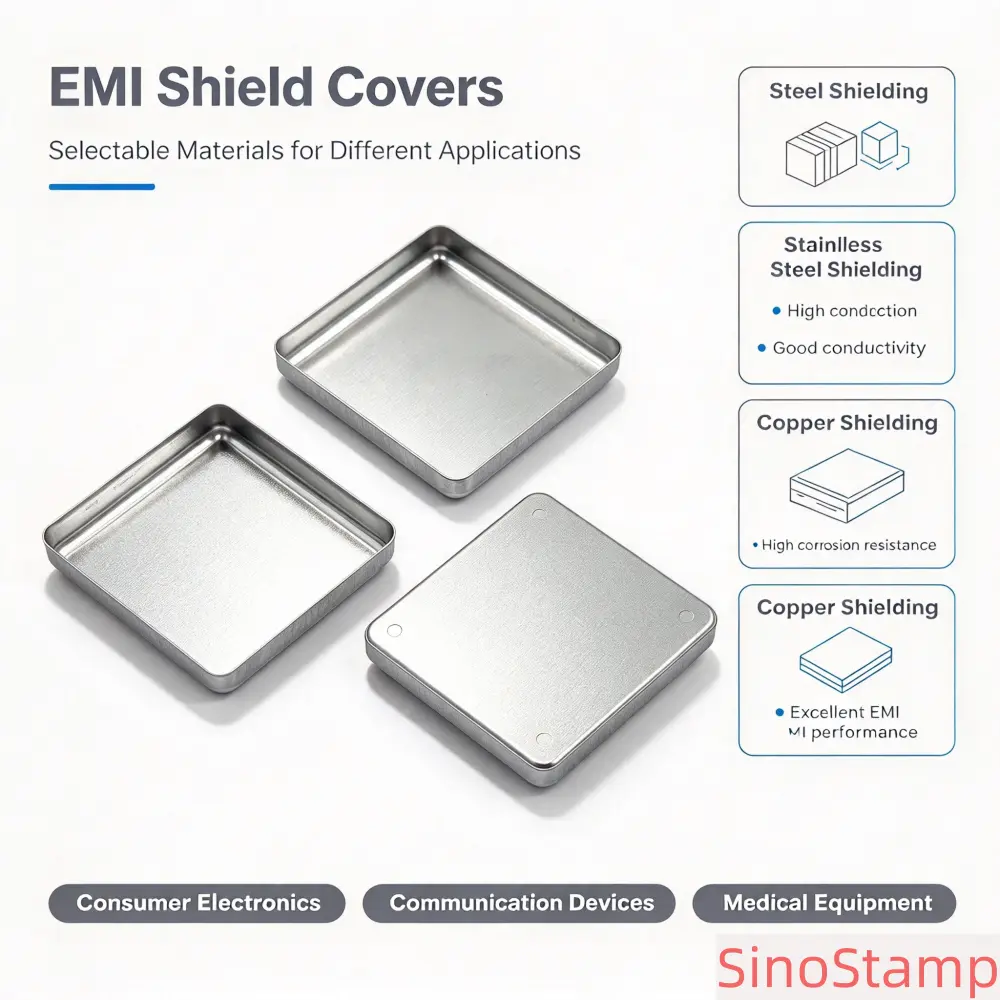
Electronic Shielding Covers
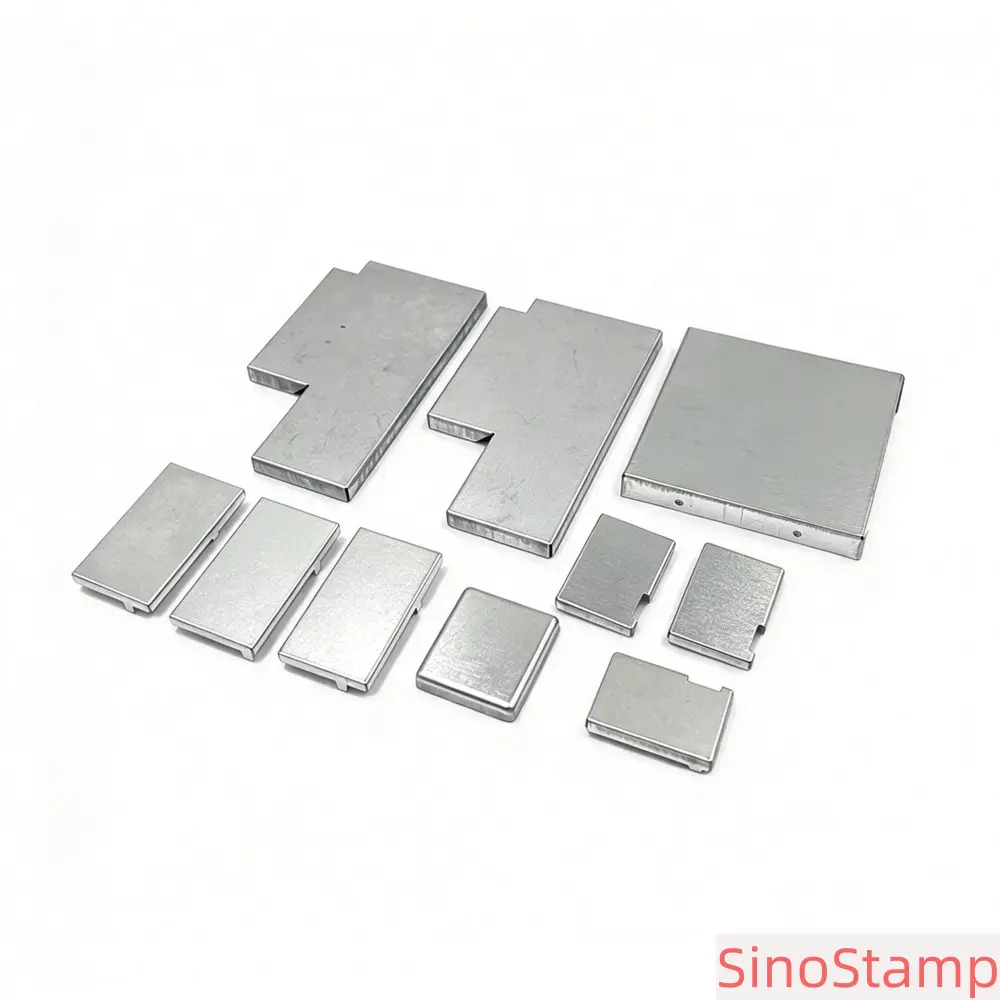
Electronic shielding covers are commonly used to help control electromagnetic interference in electronic assemblies. They may be produced from tinplate, stainless steel, copper, or nickel silver, depending on the application requirements.
Simple covers with relatively straightforward profiles may be produced using separate stamping and forming operations. Components with multiple cutouts, tabs, and repeated features may be candidates for progressive die stamping when production demand justifies the tooling investment.
For shielding applications, dimensional fit, grounding contact, installation conditions, and the complete assembly design all influence the final shielding performance. Buyers should not evaluate shielding performance based only on the manufacturing process.
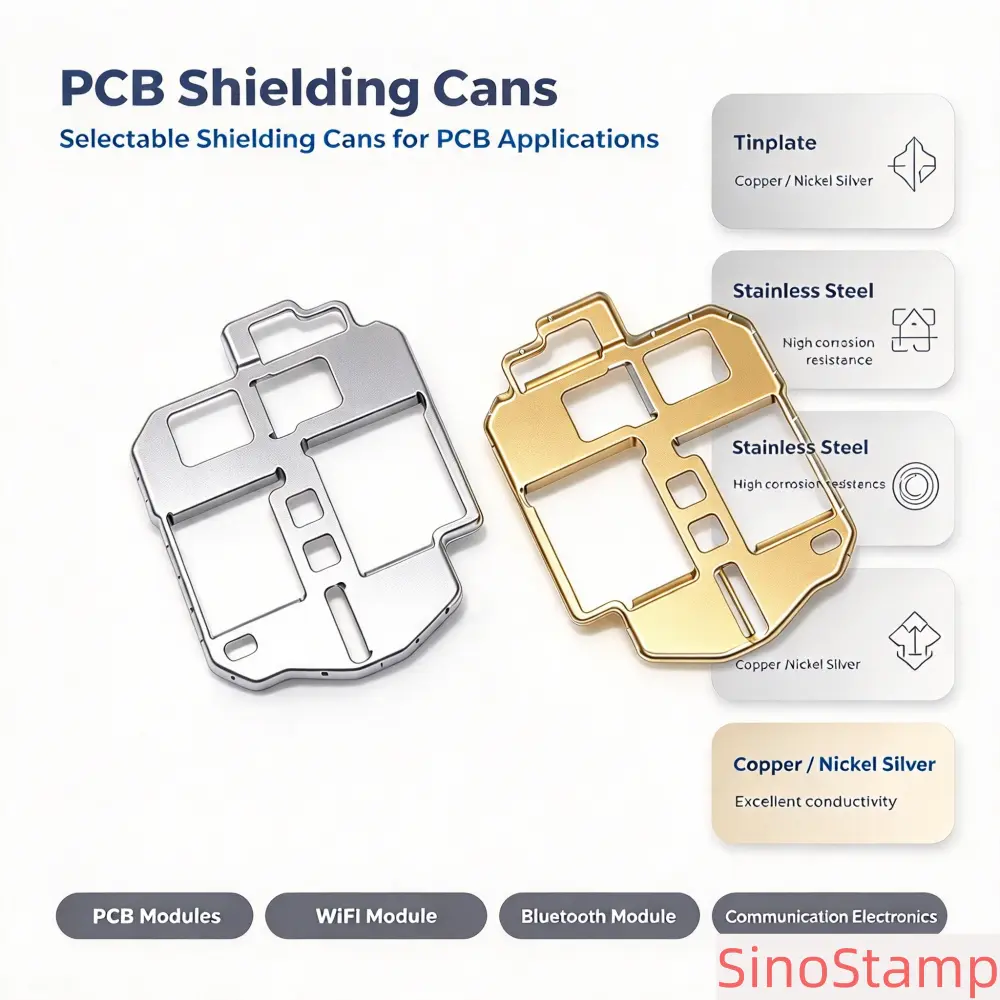
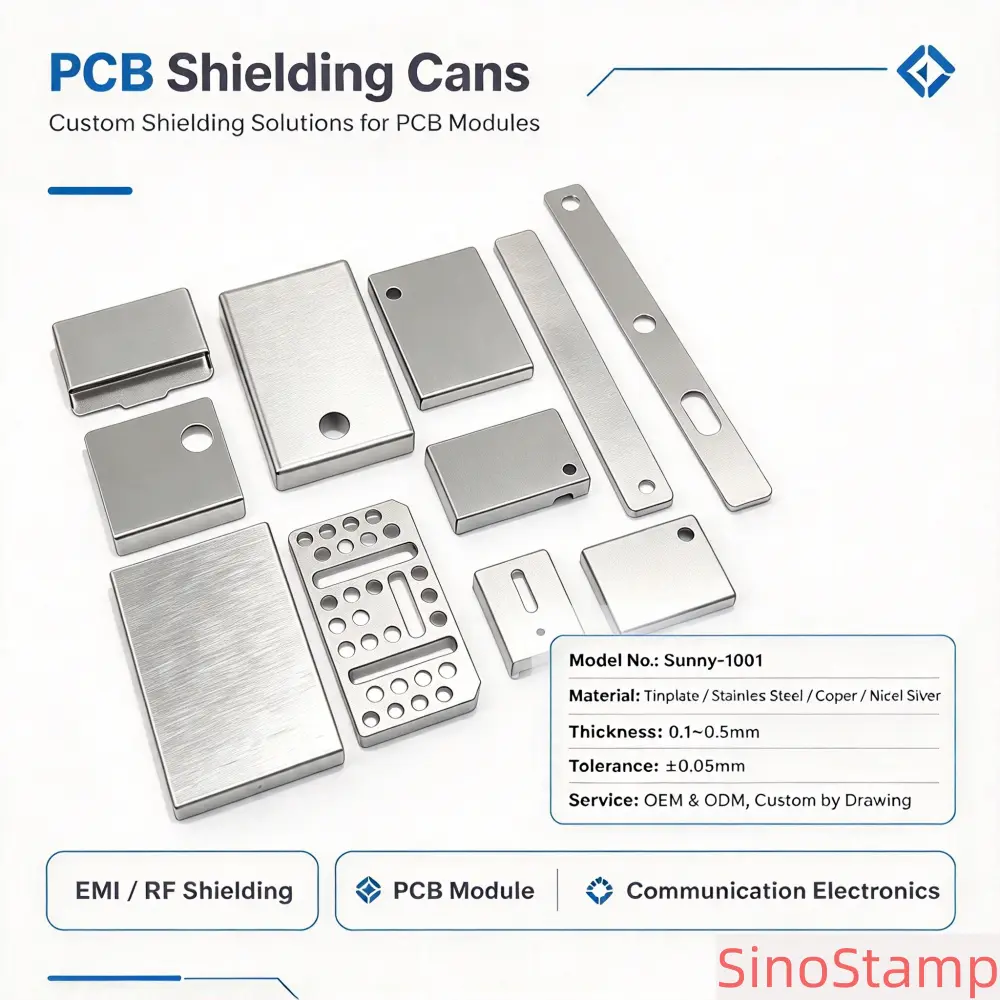
PCB Shielding Cans
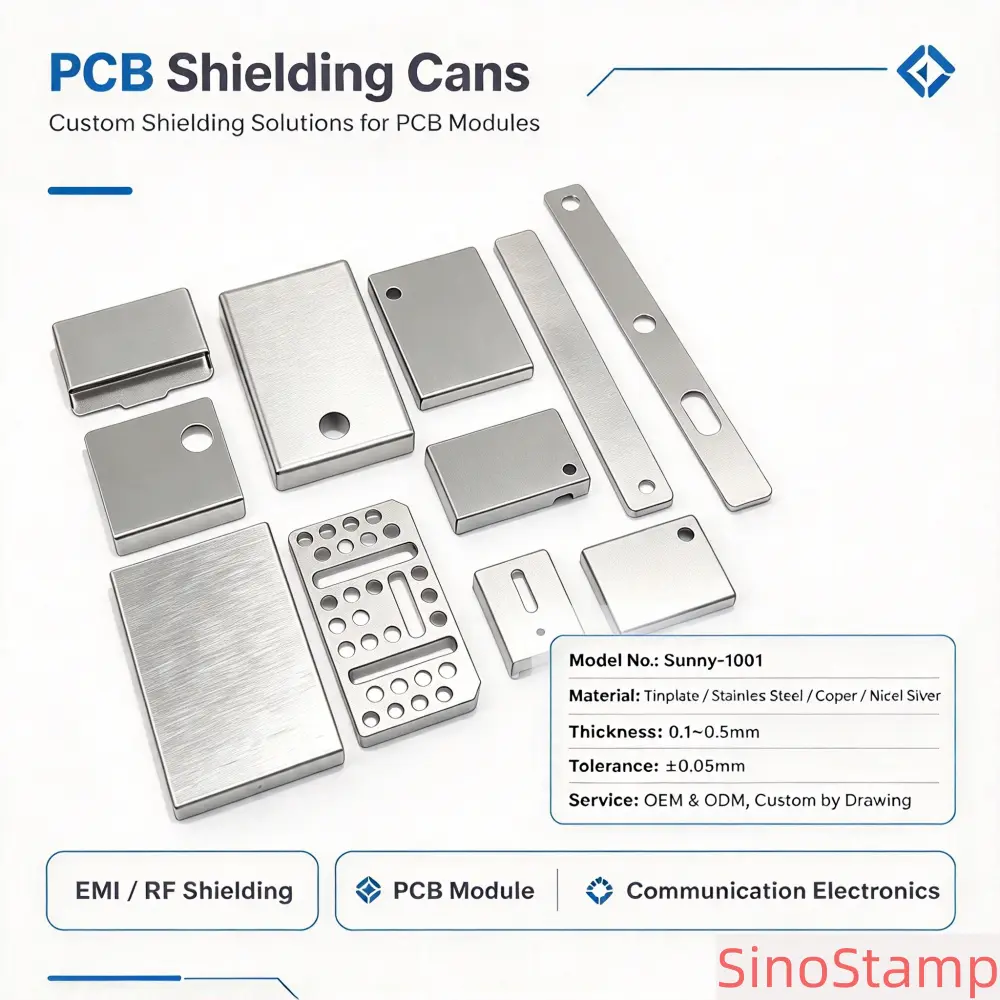
PCB shielding cans often require precise profiles, walls, cutouts, and mounting features. The manufacturing approach depends on the shape, material thickness, forming depth, and production quantity.
For some designs, a combination of blanking, forming, and bending operations may be appropriate. For stable, higher-volume components with repeated features, progressive tooling may provide a more efficient production arrangement.
Sample evaluation should confirm the dimensions, fit, surface condition, and compatibility with the PCB assembly process.
Electrical Terminals and Connector Contacts
Electrical terminals and connector contacts frequently require repeated holes, tabs, contact features, and controlled bends. Copper and brass alloys are commonly considered for these applications because of their electrical and forming properties.
Progressive die stamping is often suitable for stable, high-volume terminal production because multiple operations can be integrated into one continuous process. For prototypes or low-volume parts, separate stamping operations may be more economical.
Appliance Mounting Brackets
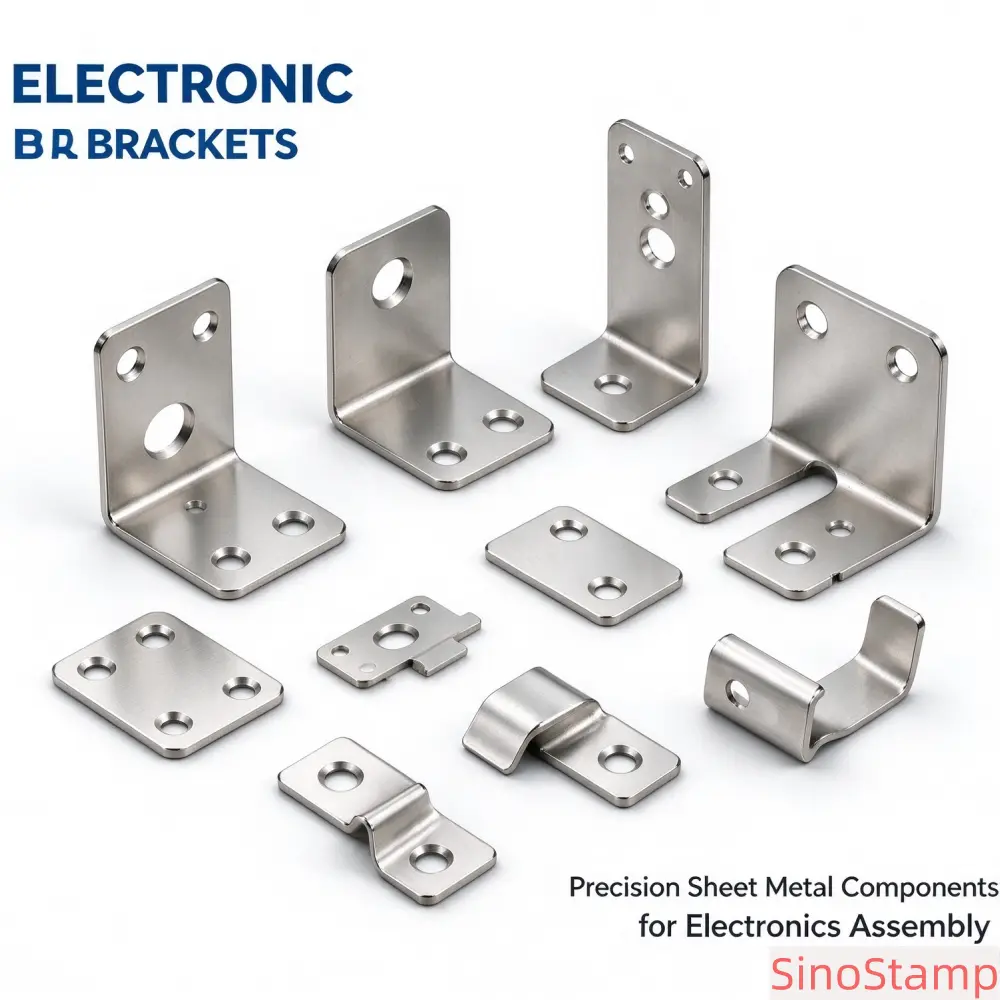
Appliance brackets may involve blanking, punching, bending, and forming operations. Some components are relatively simple, while others have several mounting features and structural requirements.
For lower-volume brackets with straightforward geometry, single-stage stamping or a combination of separate operations may be practical. For high-volume parts with stable designs, integrated tooling may improve production efficiency.
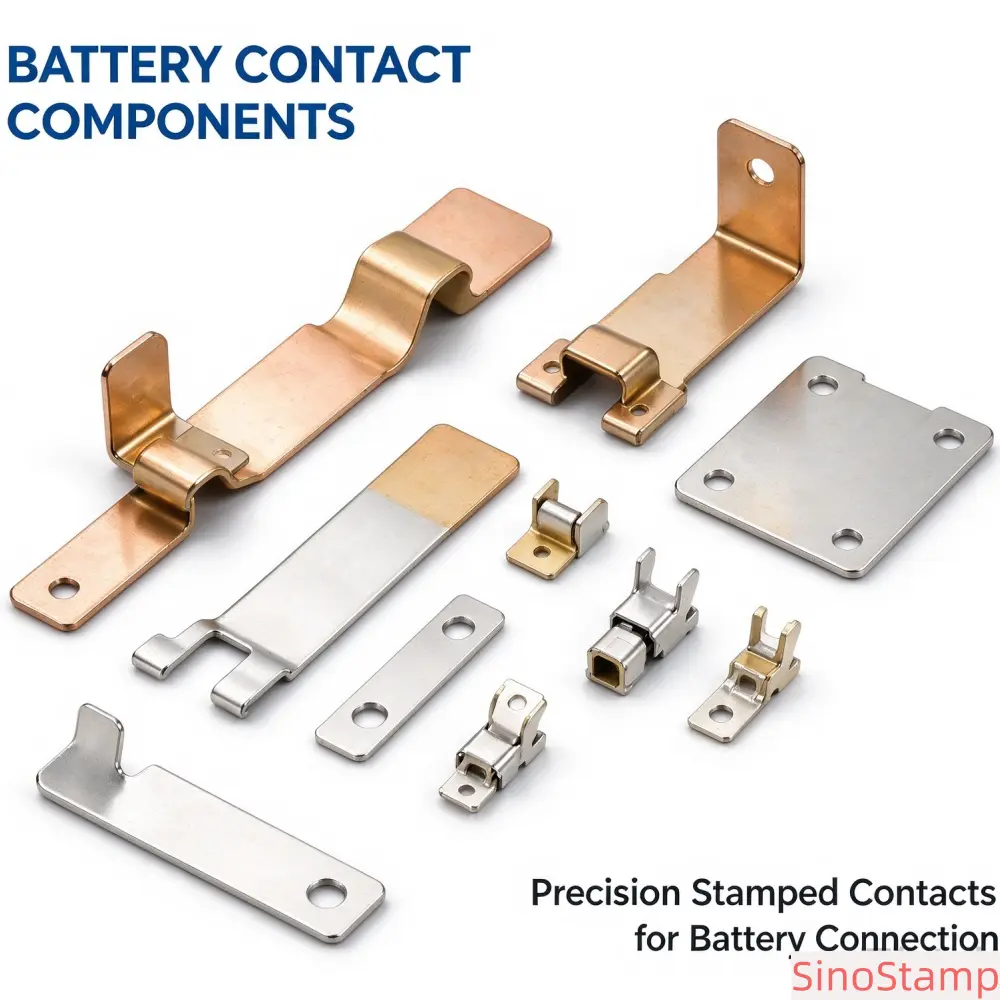
Battery Contact Components
Battery contact components may require specific material properties, contact geometry, and dimensional consistency. Depending on the design and demand, both progressive and separate stamping operations may be considered.
Material selection, surface finish, contact force, and electrical requirements should be reviewed during the engineering stage. Functional testing may be required in addition to dimensional inspection.
11. A Practical Decision Guide for OEM Buyers
Before selecting a stamping process, OEM buyers should review the project from both engineering and commercial perspectives. The following questions can help guide the decision.
Choose Progressive Die Stamping When:
- The component requires multiple stamping operations.
- The product design is stable and approved.
- Production demand is substantial or expected to grow.
- Reducing manual handling is an important objective.
- Consistent repeat production is required.
- The tooling investment can be justified by expected production volume.
Consider Single-Stage Stamping When:
- The component requires only one or a small number of operations.
- The initial order quantity is relatively low.
- The product design may still change.
- A simpler tooling arrangement is commercially attractive.
- Separate operations provide better flexibility for the part geometry.
- The project does not justify a complex progressive die.
These are general selection guidelines rather than strict rules. A complete engineering review may identify other suitable manufacturing arrangements, including compound dies, transfer dies, or combinations of different stamping processes.
12. Why Engineering Review Matters Before Tooling Development
One of the most important steps in a custom metal stamping project is reviewing the component design before committing to tooling. A drawing may describe the required finished part, but it does not always show the most economical or reliable way to manufacture it.
An experienced stamping supplier should review the design and consider the following issues:
- Whether the material is suitable for the required forming operations.
- Whether the specified material thickness is practical.
- Whether holes and cutouts can be produced without affecting part strength.
- Whether bends and formed features may create cracking or deformation risks.
- Whether the component requires progressive, single-stage, compound, or transfer tooling.
- Whether critical dimensions can be controlled through the proposed process.
- Whether secondary operations are required after stamping.
- Whether the design can be optimized to reduce material waste or manufacturing cost.
Early engineering review can help identify potential problems before tooling development. It can also help buyers understand the relationship between design decisions, manufacturing costs, and production efficiency.
For overseas OEM projects, clear communication during this stage is particularly important. Buyers should provide the latest drawing revision, material specifications, estimated demand, and application information so the supplier can make a meaningful process recommendation.
13. What Information Should You Provide When Requesting a Stamping Process Recommendation?
If you are not sure whether progressive die stamping or single-stage stamping is suitable for your project, you do not need to decide the manufacturing process before contacting a supplier. A qualified manufacturer can review the requirements and recommend a practical approach.
To support an accurate evaluation, prepare the following information:
- 2D Engineering Drawing: Include dimensions, tolerances, material specifications, and surface finish requirements.
- 3D CAD File: Provide a 3D model when available to help the manufacturer understand complex geometry.
- Material Information: Specify the material grade, thickness, and condition where applicable.
- Annual Demand: Provide the expected annual quantity and estimated order size for each production run.
- Application Details: Explain how the component will be assembled and used in the final product.
- Critical Quality Requirements: Identify important dimensions, functional features, and inspection requirements.
- Development Schedule: Provide your target sample approval date and expected production start date.
With this information, the manufacturer can evaluate possible tooling structures, production sequences, sample development requirements, and cost considerations.
14. Frequently Considered Factors When Comparing Production Methods
OEM buyers often focus on the initial tooling quotation when comparing manufacturing processes. However, a better decision requires considering the total cost over the expected life of the product.
For example, a progressive die may require more investment at the beginning but offer lower processing costs per part when production volume is high. A single-stage process may require less initial investment but involve additional handling or separate tooling when the component requires several operations.
The total project cost should consider:
- Initial tooling development.
- Material consumption and scrap rate.
- Press setup and production time.
- Labor and material handling.
- Secondary operations.
- Inspection and quality management.
- Tooling maintenance and repair.
- Expected order quantities and product life cycle.
It is also useful to request quotations for alternative manufacturing approaches when the part design allows more than one solution. Comparing different process proposals can help OEM buyers understand the trade-offs between initial investment, production efficiency, and long-term unit cost.
Conclusion: Select the Stamping Process That Fits Your Project
Progressive die stamping and single-stage stamping are both useful manufacturing methods for custom metal components. The right choice depends on the component design, number of required operations, material properties, tooling budget, production volume, and long-term supply expectations.
Progressive die stamping is often a strong option for stable, repeat-production components that require multiple operations and substantial production quantities. Its integrated tooling structure can improve manufacturing efficiency and reduce intermediate handling.
Single-stage stamping is often practical for simple parts, prototype development, and lower-volume projects where a complex integrated die may not be commercially justified. It can also provide flexibility when individual operations need to be adjusted.
For OEM buyers, the most effective approach is to evaluate the complete manufacturing process rather than selecting a method based on one factor alone. Tooling investment, material utilization, quality requirements, production output, and future demand should all be considered before confirming a manufacturing plan.
Working with a metal stamping supplier that understands both production methods can help identify a solution that balances technical performance, manufacturing cost, and long-term supply requirements.
About SinoStamp: Custom OEM Metal Stamping Solutions
SinoStamp is a China-based metal stamping supplier focused on customized metal components for OEM and industrial applications. Our product range includes electronic metal stamping parts, electrical metal stamping parts, and home appliance metal stamping parts.
We support custom manufacturing based on customer drawings, samples, and technical specifications. Depending on project requirements, our manufacturing solutions may involve precision stamping, progressive die stamping, separate stamping operations, bending, forming, and coordination of suitable surface finishing processes.
For OEM customers, selecting the right production method is an important part of controlling tooling investment, product quality, and long-term manufacturing costs. We can review your component drawings, material requirements, estimated order quantities, and application details to evaluate suitable manufacturing options.
Whether you need electronic shielding covers, PCB shielding cans, copper terminals, electrical contacts, appliance brackets, or other custom metal stamped components, SinoStamp welcomes your project requirements for technical evaluation.
To request a quotation or manufacturing recommendation, please prepare your 2D drawings, 3D files if available, material specifications, annual demand, and surface finishing requirements. This information will help us assess the project and recommend an appropriate production approach.
```